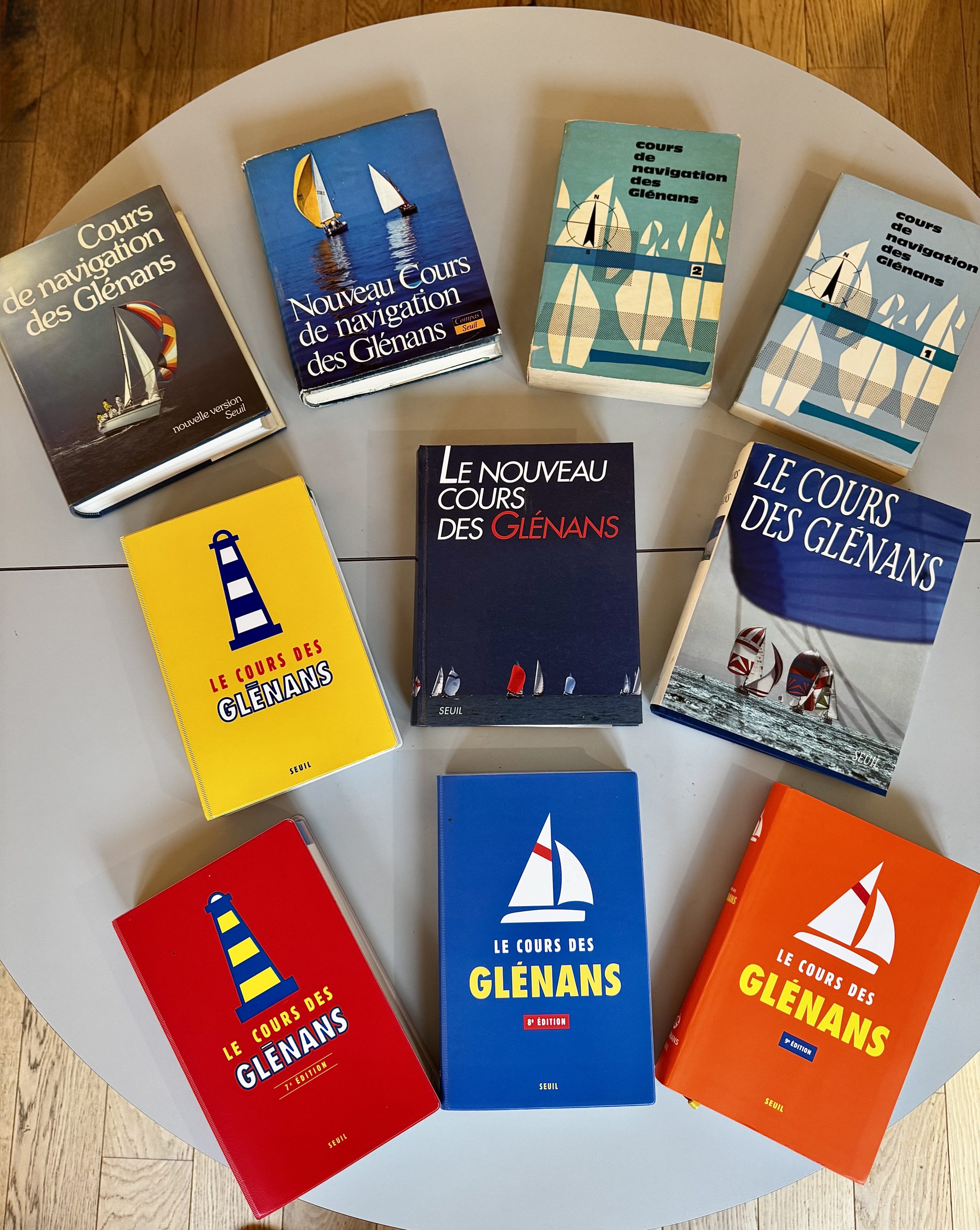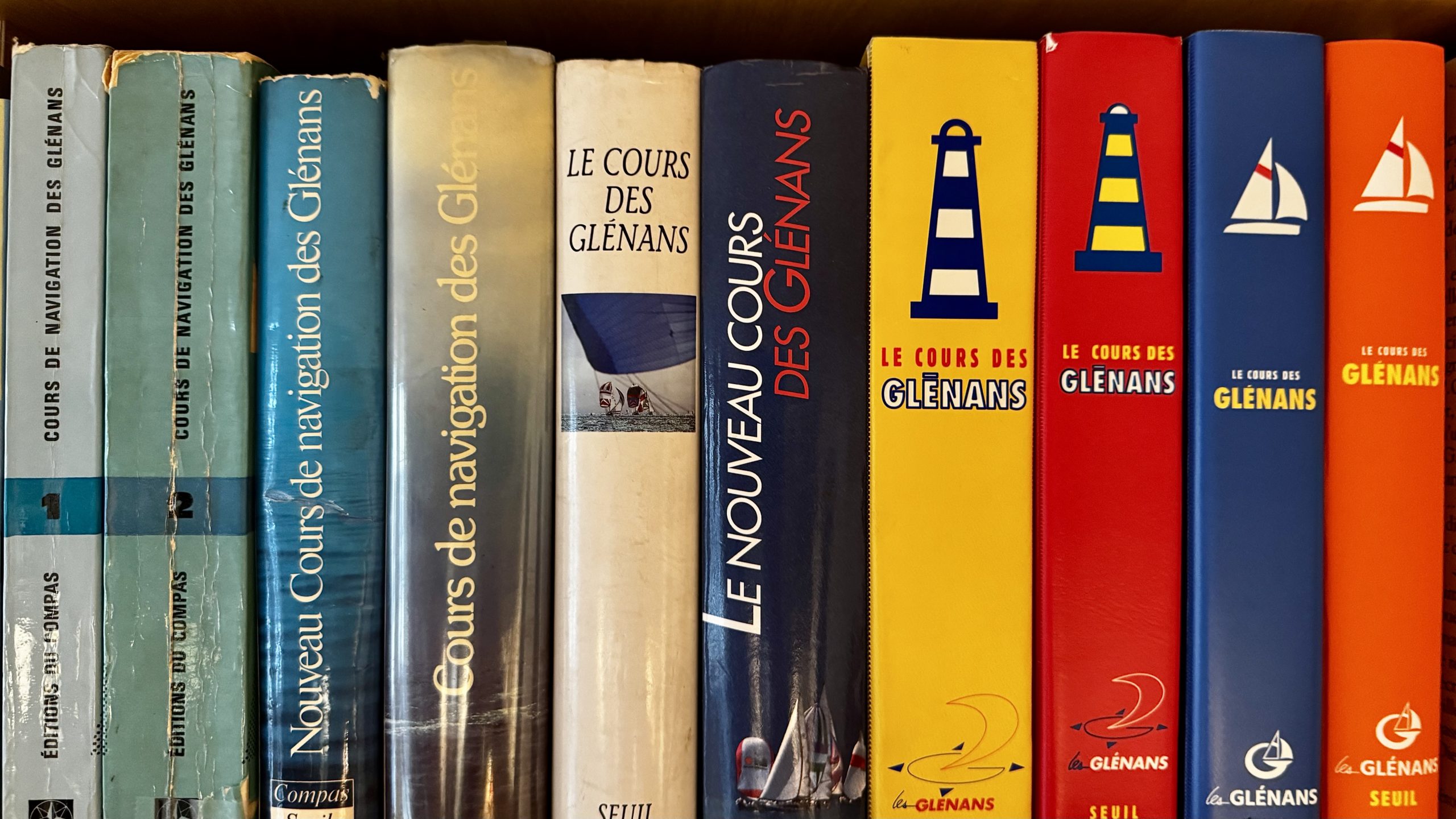
The Glénans Manual, Sailing in 10,000 pages
The population grows, yet the number of readers declines. Books that are continually reissued and distributed in their hundreds of thousands over decades are rare. The Bible still leads the field, of course. But another work of more than a thousand pages also claims a prominent place, both on bookshelves and in the Guinness World Records. Almost a sacred text in the eyes of enthusiasts, better than an encyclopedia for practitioners, far more than a textbook for lifelong scholars of the wind and the waves, The Glénans Manual earns its place on the podium.
At the end of 2024, under a laminated orange cover, this yachtsman’s missal reappears in well-stocked bookstores with this label: 9th Edition. It is worth noting from the outset that this rigorous maritime manual is not without its paradoxes: page 1023, titled Bibliography, lists the “Ten editions of The Glénans Manual”! And opens with this statement: “From 1952 to 2024, The Glénans Manual has seen eleven successive editions, including this one”.
Is this a touch of humor in the spirit of Jerome K. Jerome, whose bestseller “Three Men in a Boat” famously begins by saying: “There were four of us”?
Be that as it may, readers of The Manual are forewarned: the most famous sailing school may be navigating in slightly foggy waters when it comes to keeping track of its printed legacy. Let’s take a closer look why.
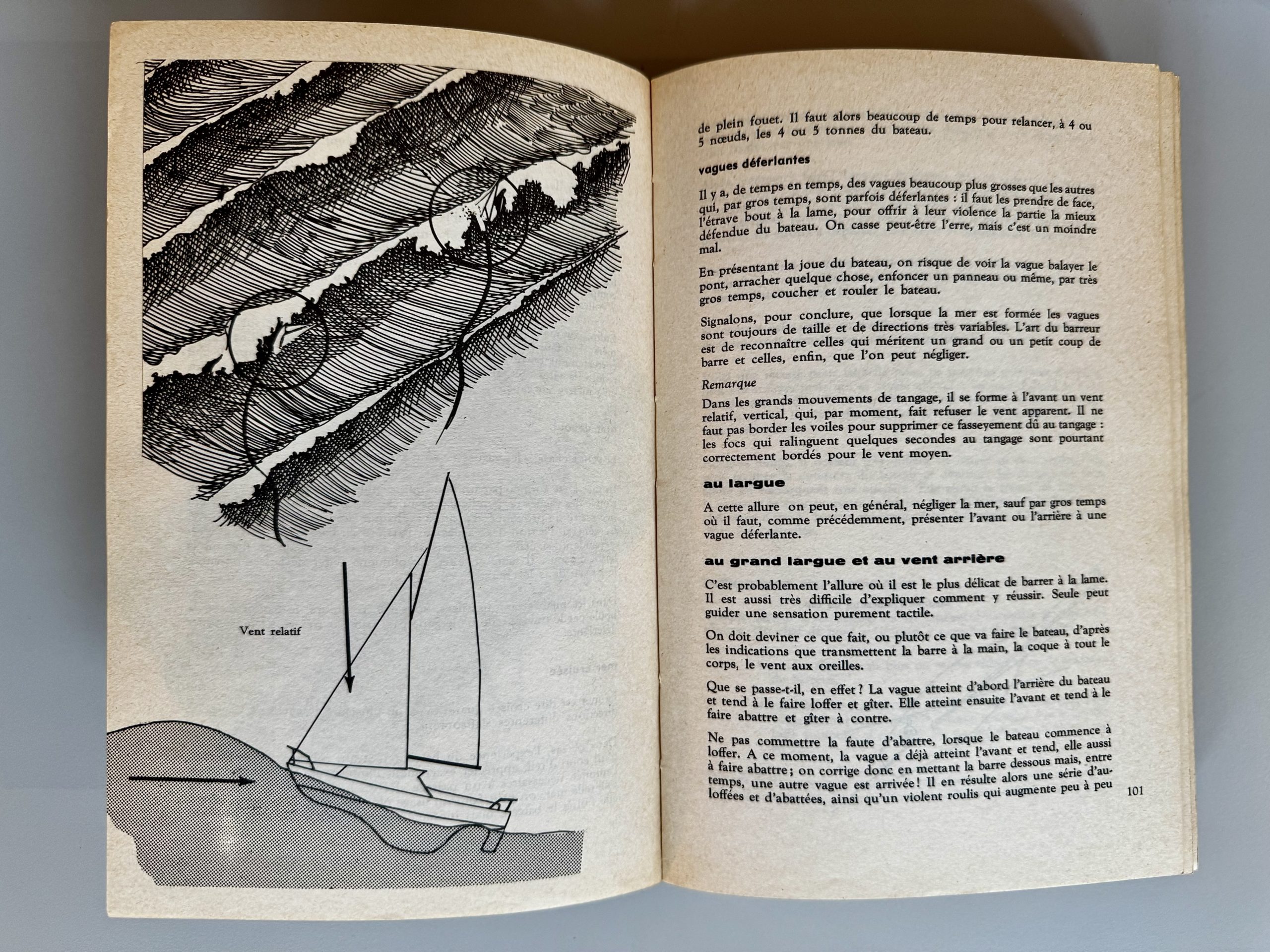
Born out of the war and the Resistance, the Centre Nautique des Glénans sought to heal the wounds of a generation by teaching them the sea, the wind, the sail and the horizon. The archipelago’s pioneers taught the practice of sailing even as they themselves were still learning its theory. In 1952, then again in 1954, their knowledge was recorded on mimeographed sheets that smelled of methylated spirits and proved ill-suited to seawater. Nine years later, these rudimentary documents became the first true edition of The Glénans Sailing Manual. Éditions du Compas, whose address was the same as that of Bateaux magazine, published Volume I of a two-part work which, in nearly 1,200 pages, contained not merely knowledge of the sea and sailing boats, but a way of seeing and approaching what was not yet called recreational sailing.
Published in 1961, Volume I is devoted entirely to the discovery and practice of “light boats”, in other words, primarily dinghies, and secondarily racing keelboats. In its foreword, one of the key figures who helped bring sailing to prominence in France wrote:
“Sailing is developing in France year by year, yet many more would take up this fascinating sport if their first steps were made easier. To this end, the Glénans Center is constantly refining its teaching methods and its organization”.
These words were signed by Jean-Jacques Herbulot, the father of the Vaurien, the Caravelle, the Corsaire and many other simple, seaworthy, efficient and affordable sailing models.
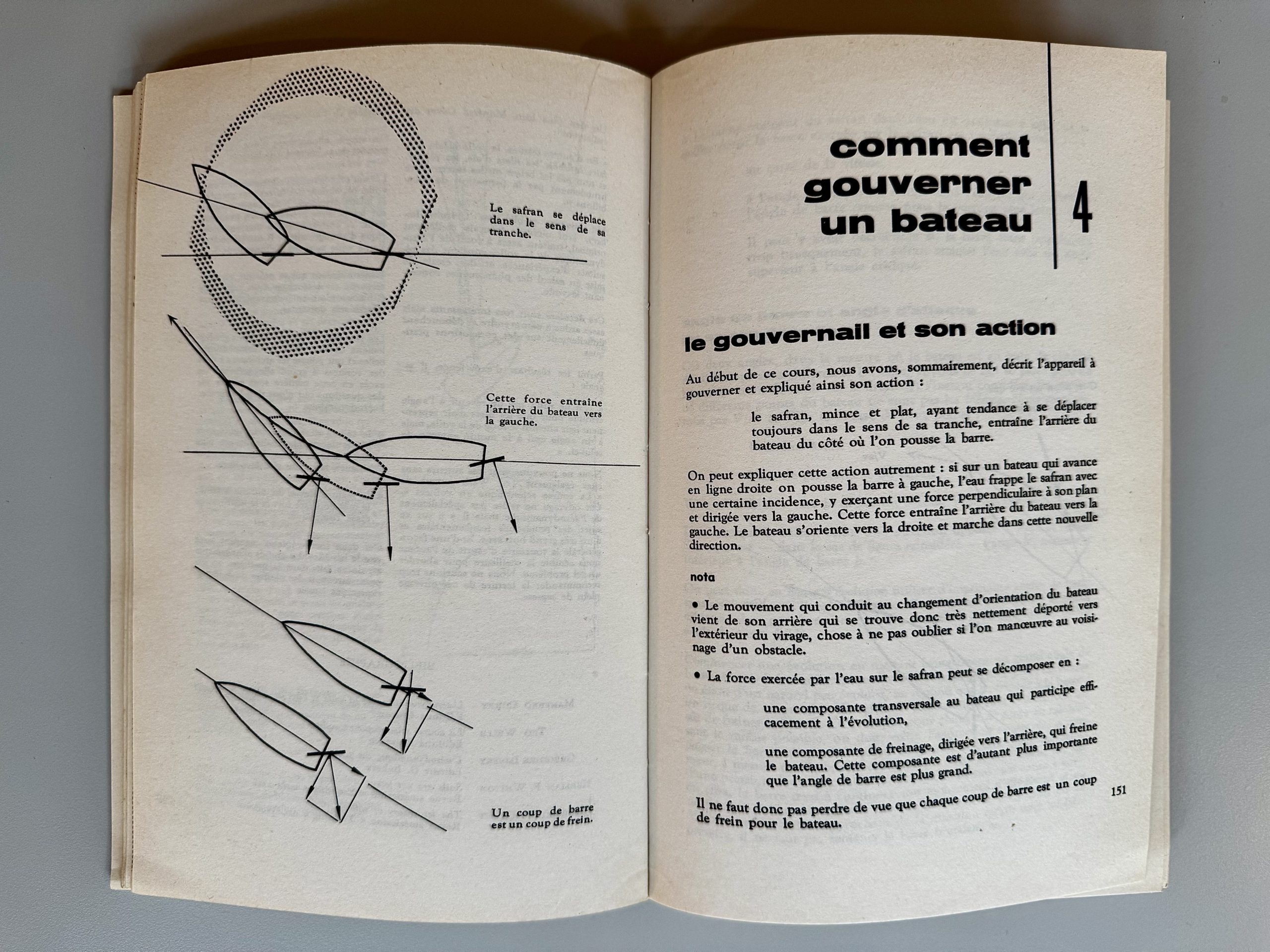
This first Glénans Manual comprises 10 chapters focused on what is largely unknown at the time: leisure and sport sailing boats. Their titles speak for themselves: 1/ Boat. 2/ Hull. 3/ Sail plan and rigging. 4/ Steering a boat. 5/ Dinghy sailing in practice. 6/ Points of sail. 7/ Maneuvers. 8/ Safety (in dinghy sailing). 9/ Practical data (hull). 10/ Practical data (spars, sails and rigging). All illustrated with hundreds of remarkably clear and informative drawings.
At the dawn of the 1960s, recreational boating still relies on timber for the hulls, cotton for the sails and hemp for the ropes, even as polyester will soon consign these noble materials to the museum. The first volume of The Glénans Manual states: “A fabric or rope, when wet, swells and shortens. A sail that is fully soaked will therefore be smaller than a dry sail”. It goes on to explain that, because a soaked sail dries unevenly, it must be re-tensioned – tightening the luff – every 15 to 30 minutes, yet unsightly creases will inevitably appear, giving it the rather unappealing look of a canvas sack. Another era entirely, which seems closer to the age of wooden sailing ships than to our own.
A Star : The sailing boat
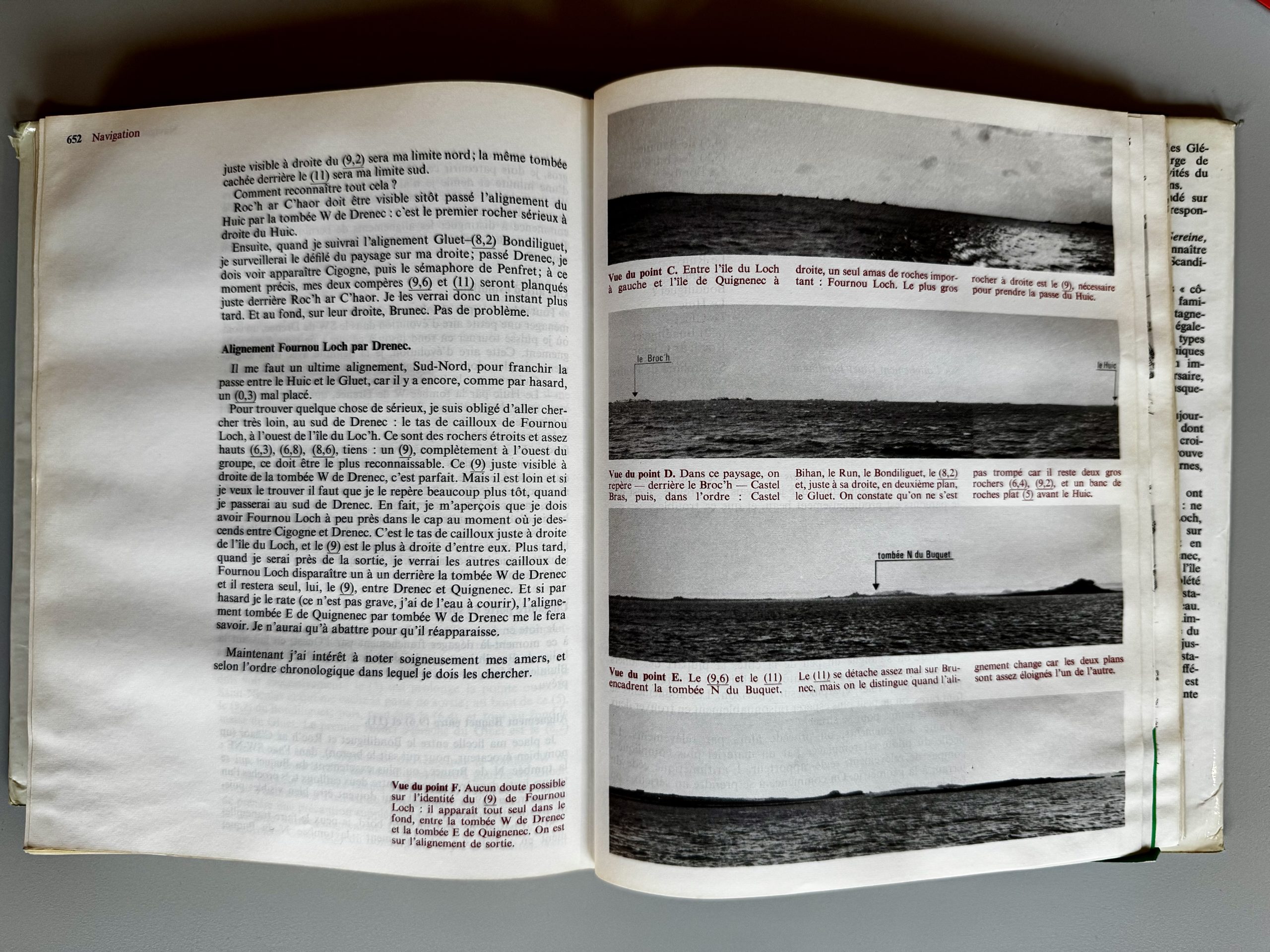
The 725 pages of Volume II of The Glénans Manual, published in 1962, set course for the open seas. They are devoted entirely to liveaboard boats and sailing far away from the coast. In its foreword, another leading naval architect explains:
“(…) A deep understanding of isolated beginners and self-taught sailors has shown us how much more difficult it has become to acquire nautical knowledge than to acquire a boat. We therefore envisaged a wider circulation for this work beyond the Glénans and accordingly sought to give it a more general scope, avoiding, as far as possible, the particular features that are specific to us”.
How elegantly these things are expressed! They are the words of Philippe Harlé, a pillar of the Center, editor-in-chief of the Manual, worthy heir to Jean-Jacques Herbulot, and designer of the Muscadet and many other legendary yachts.
For his part, Philippe Viannay, a leading Resistance figure and founder, with his wife Hélène, of the Brittany school of sailing – and way of life – writes in his introduction:
“For this wonderful game, cruising, cannot be improvised. It is the constant synthesis of several variables, each of which must be understood precisely, both in itself and in its interaction with others. A lack of understanding, or the inability to harmonize them, leads to accidents, sometimes to tragedies, made all the more serious because they are almost always collective.
These variables are the boat, its condition and capabilities; the crew, their competence and training; the shape and relief of the coastline; the immediate and forecast visibility; the state of the sea; the wind, its strength, direction and tendency; the currents; and the specific nature of a given sea”.
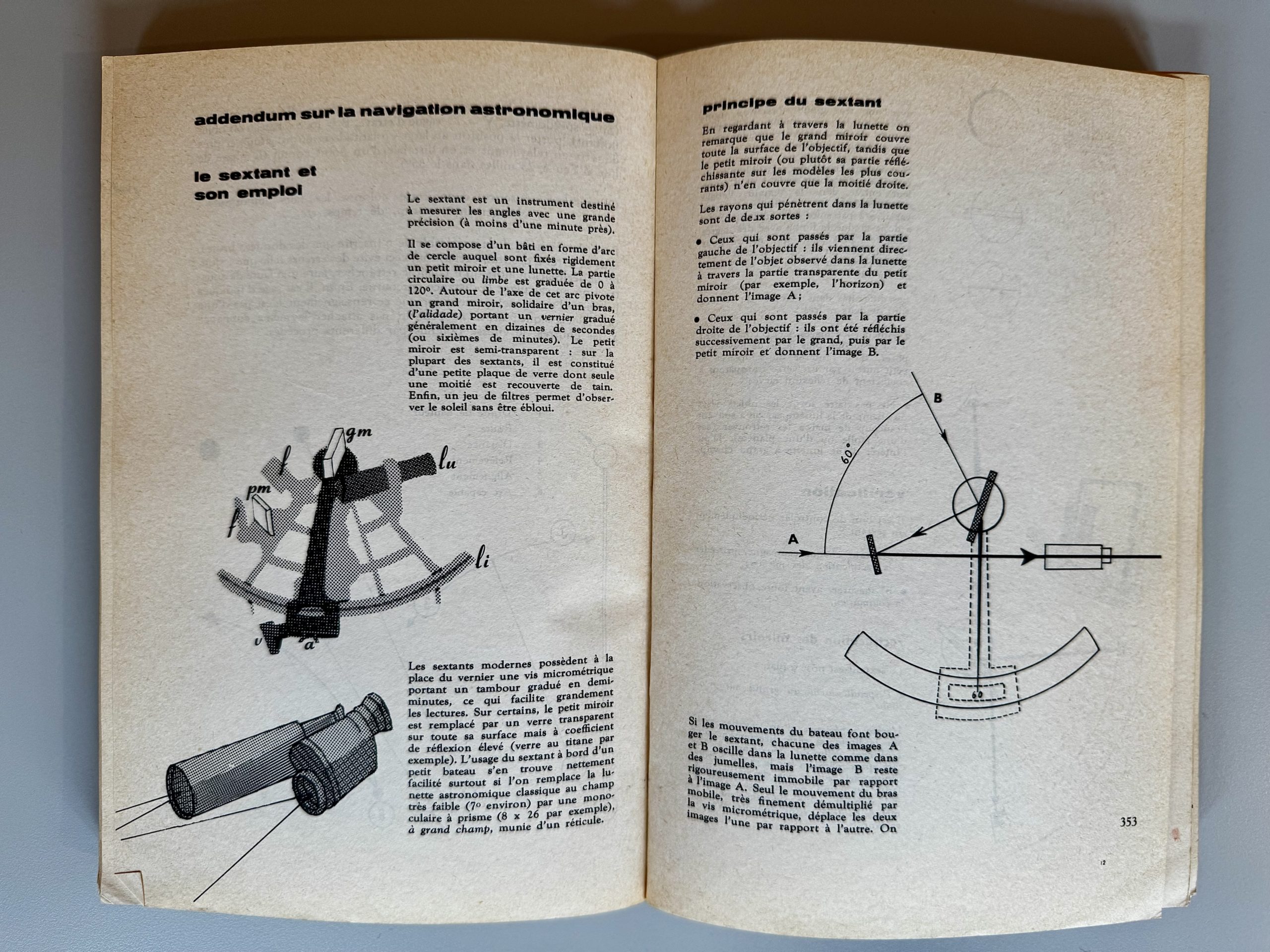
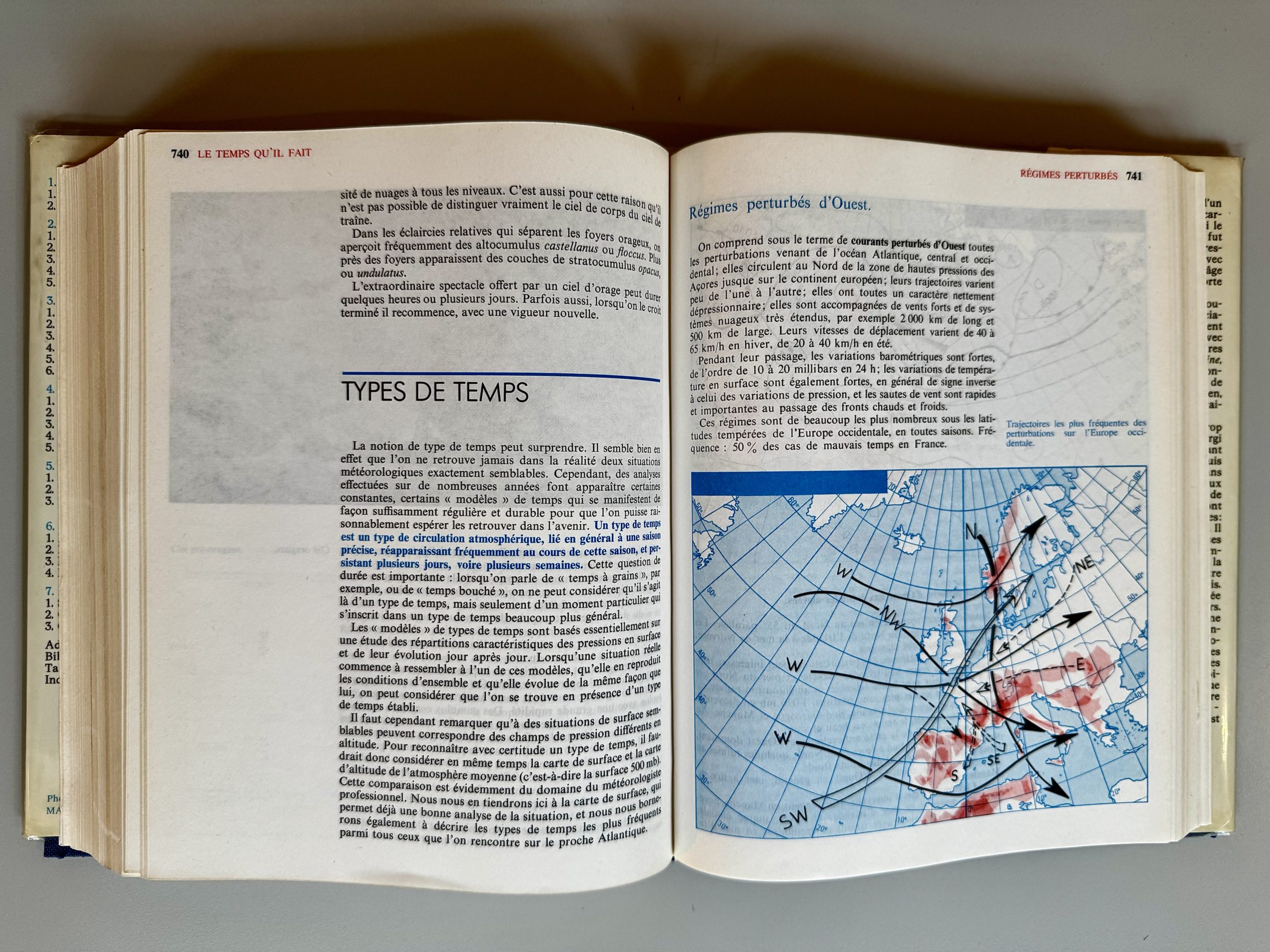
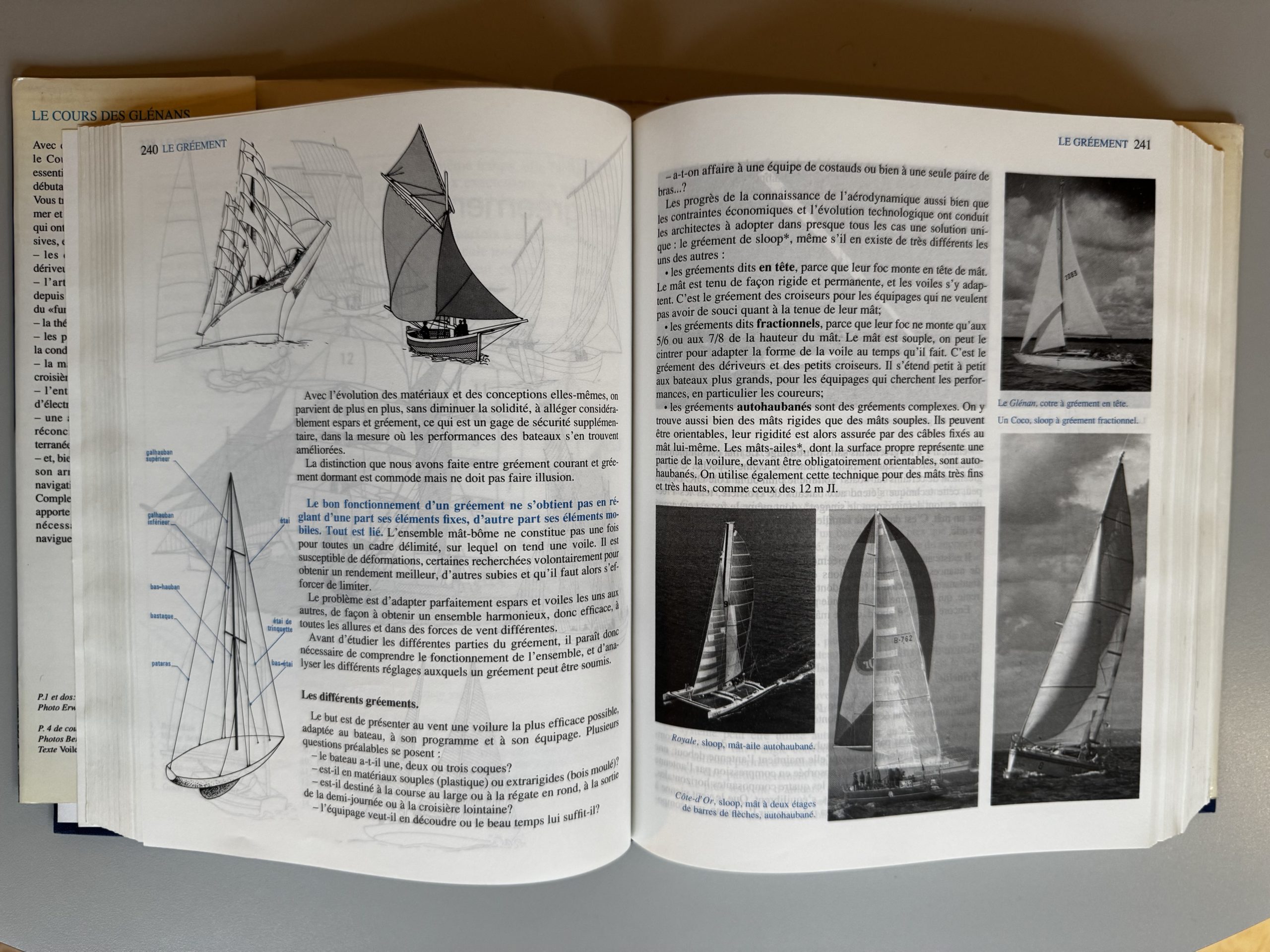
The nine chapters of the volume therefore focus first and foremost on the boat itself, with the theorems and physical forces at play (thank you Archimedes), the technology (materials, their advantages, limitations and ageing, hull construction processes, different types of rigging, standing rigging, ropes, etc.), maintenance and how to lay up a boat for winter, since we do not sail year-round, before recommissioning it in the spring. But they also address life on board, the handling of a cruising yacht and navigation, the art of knowing where you are and where you are going, along with an appendix on celestial navigation using a sextant, before concluding, somewhat boldly, with an “introduction” to offshore racing.
Once again, the dozens of illustrations are designed as much to inspire as to instruct. One example, on page 224, shows a Corsaire, one of the smallest cruising yachts of the time, out at sea. The mainsail is reefed, the sea is heavy, a crest is about to break. Yet the valiant little vessel presses on, far from the coast. Enough to fire the imagination of a generation of future followers of Éric Tabarly.
While rigorously informative and educational, the tone of the work allows itself moments of humor as well. For instance, this passage on the hand lead, a lump of lead greased with tallow and attached to a thin line marked at meter intervals: “If the lead comes up with sand, the seabed is sand. If the lead comes up with nothing… the line is too short!” Plain common sense…
However, the explanations relating to the art of steering in breaking seas, and more broadly handling a boat in heavy seas, are somewhat vague and distinctly dated. One example explains how to interrupt “rhythmic rolling” when large following seas build astern: “Shake the tiller rapidly from side to side”. It should be remembered that, at the time, wheel steering is rare, and offshore sailing hulls are narrow, deep and heavy, incapable of surfing or planing. Rolling at this point is such a universal curse that a saying seems designed to console poor sailors with delicate stomachs: “Good roller, good sailor”.
The first two editions of the Glénans Sailing Manual stand as both a reflection of and witness to their time. Their tone wavers between the faith of the discoverer, the naivety of the novice, and the rigor of the good teacher. The baby-boomer generation discovers, with delight, the magic of the dinghy. Sailing is first and foremost a sport. As for cruising, it is a new, rustic practice, most often limited to coastal passages of varying range along the shores of France.
Over the course of the next eight editions, the Manual will renew itself, adapt, shed some of its more peremptory certainties, and reflect both its own era and the evolution of sailing practices. The focus on the boat itself will gradually give way to a holistic approach to living the sea and sailing. Which sees sailing move from a near-mystical passion to a mass leisure activity.
Sailing, a lifestyle
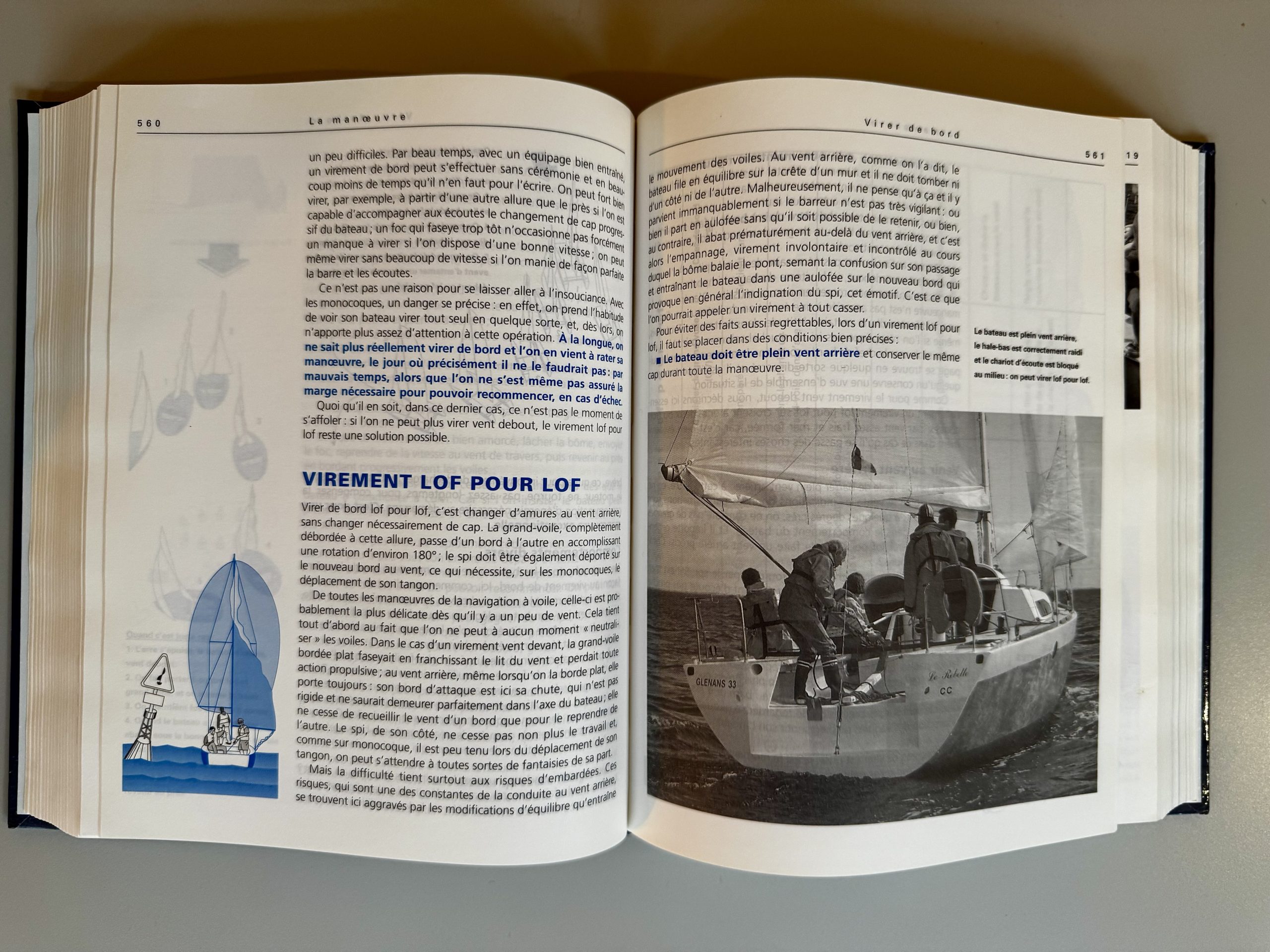
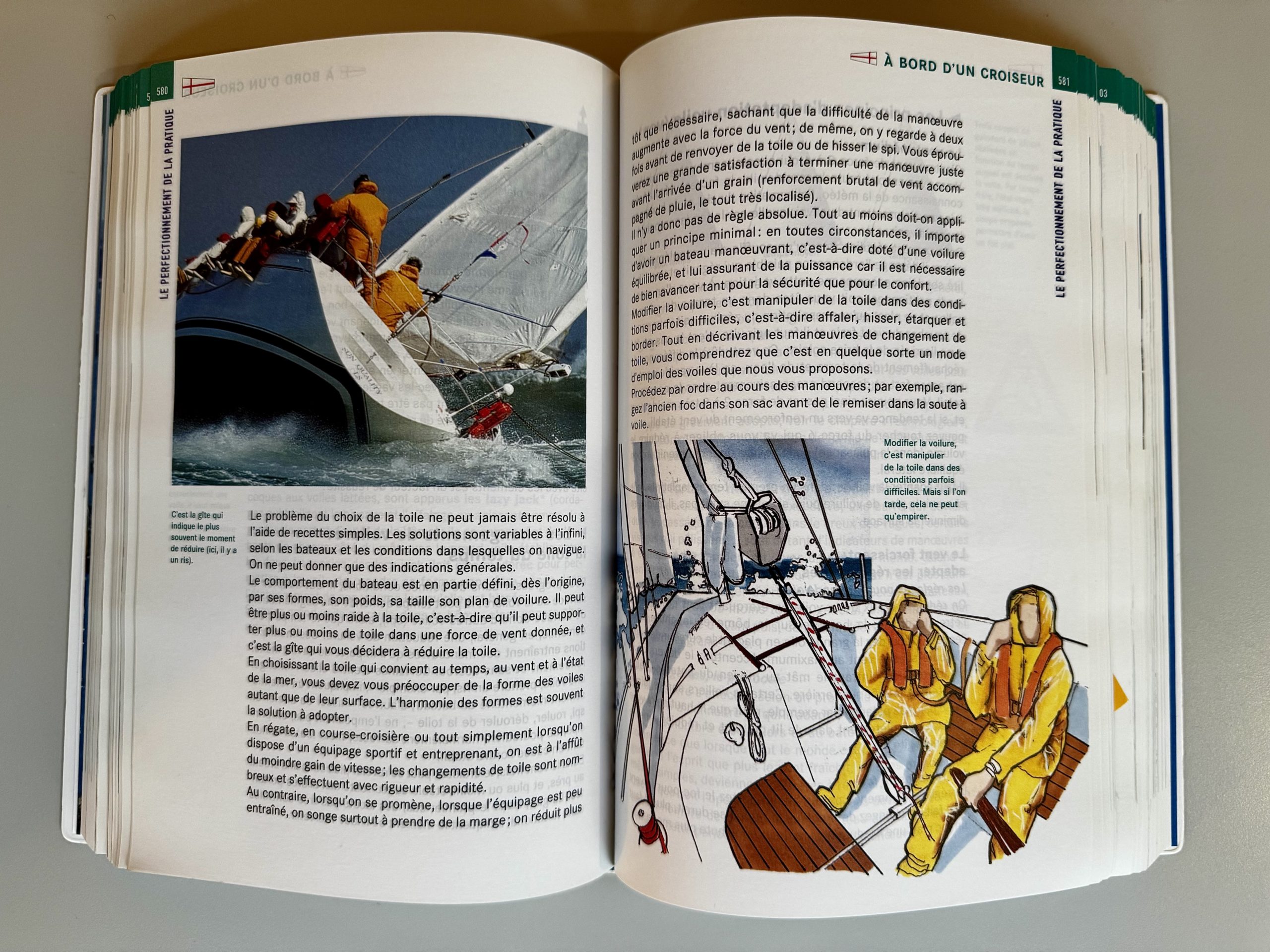
In 1972, the New Glénans Sailing Manual, published by Éditions du Seuil like all subsequent editions, appears as a handsome, single-volume hardback that brings together the two earlier volumes. Richly illustrated with more detailed drawings, it introduces black-and-white photos and incorporates real nautical charts. Above all, it introduces a development that will continue to evolve over the next 50 years: meteorology. This marks the beginning of the continuous developments that will shape later editions in 1982 (Glénans Manual of Sailing), 1990 (Glénans Manual), 1995 (The New Glénans Manual of Sailing), and then 2002, 2010, 2017 and 2024 (The Glénans Manual). The four most recent versions are bound volumes with waterproof soft covers, sold at a price of €59 (€62 for the latest), almost equivalent to the 395 francs required for the 1995 edition.
Initial print runs of 30,000 to 40,000 copies immediately position each edition among France’s bestselling titles.
There is not enough space here to compare the contents of every iteration of a body of sailing knowledge that has continually evolved.
From auxiliary engines, dismissed in two paragraphs in the 1962 edition as something not to be relied upon, then treated as the subject of a full manual of maneuvering and mechanics in the ninth edition, to the art of sculling, once both ancient and magical, gradually reduced and ultimately disappearing altogether in 2024; from the spinnaker, initially portrayed as a somewhat treacherous sail before becoming commonplace; from satellite navigation, entirely absent from the 1990 edition despite its emerging presence above chart tables, to today’s fully electronic navigation; from windsurfing, ignored until 1995 and later fading back into obscurity, to foils, now the subject of an entire chapter in 2024; from the art of piloting, finding your way with chart and string, stubbornly holding its ground, to celestial navigation quietly slipping into obsolescence; from position-fixing with bearings to modern routing using GRIB files, we can only admire the Glénans Manual for its remarkable ability to keep pace with changing attitudes and sailing practices over three-quarters of a century.
The foreword to the 2024 edition, simply signed “Les Glénans”, states:
“(This edition) gives new prominence to environmental issues, whether through a better understanding of the elements in which we sail or through more virtuous approaches to our practice of sailing. It also takes a closer look at life on board, and the importance of living together with mutual respect within the unique community that is a boat’s crew”.
How better to show that the Glénans and their teaching continue to sail at the very heart of their time?
Olivier Péretié et Pierre Verger
To learn more :