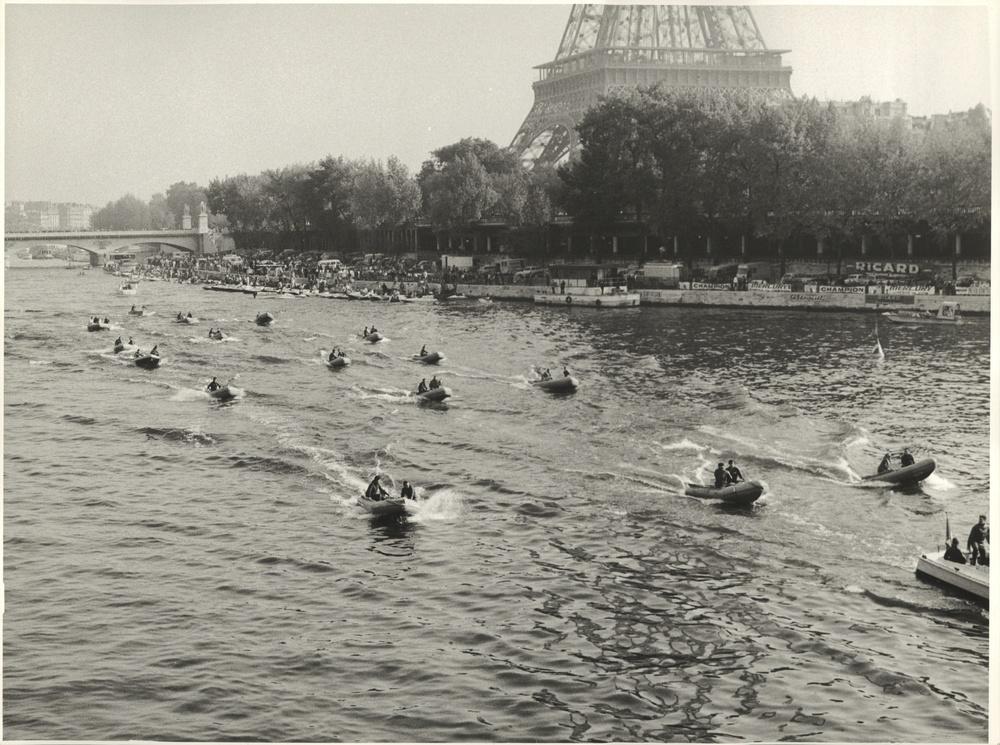
Pierre Debroutelle, Zodiac and company, the origins of the inflatable dinghy
What follows is a story of air in every sense: the air that carries balloons, airships and inflatable boats, and the spirit of the times that brings them into being. For millennia, many technological breakthroughs have emerged, almost simultaneously, from work carried out independently by individuals in countries far removed from one another. Whether attributed by some to serendipity and good fortune, or by others to a fortunate convergence of human and material factors at a particular moment, many inventions naturally give rise to competing claims over who created them first, often tinged with national pride. Photography and the first powered flight immediately come to mind, among many other examples. In the case of the modern inflatable dinghy, its popular name is still often associated with the French company Zodiac. Its designer, the aviator Pierre Debroutelle, establishes its fundamental design principles in 1934. Just like we talk today about a “Hoover” or “Biro”, the word “Zodiac” long serves as a generic term for any craft built around stitched or welded rubberized fabric tubes and powered by an outboard engine. Without venturing back to Antiquity, or revisiting the countless attempts to stay afloat using animal skins made airtight and watertight, we may simply take the discovery of rubber vulcanization as the starting point to look back over the long international voyage that ultimately leads to the “Zodiac”. The American Charles Goodyear is credited with this breakthrough in 1838, followed a few years later by the Englishman Thomas Hancock, whose work in the 1840s further refines the process. Goodyear successfully patents his discovery and, in 1853, a certain Hiram Hutchinson founds a small company in Châlette-sur-Loing, in France’s Loiret region. This American industrialist of British origin chooses France to manufacture rubber shoes and boots under the Goodyear patent, after negotiating exclusive rights. Decades later, certain materials developed by Hutchinson find applications far removed from those of the Aigle brand owned by the company, extending into the automotive, aviation, defense and cycling sectors. As an aside, the “Aigle” in question is simply the French translation of the powerful “eagle” symbol of the New World, and provides a fine example of a distinctly French brand identity fashioned from international roots.
Meanwhile, the bicycle and later the automobile begin their remarkable rise. In 1887, the British inventor John Boyd Dunlop introduces the pneumatic tire. Yet few tire manufacturers will one day turn their attention to inflatable boats, like Italy’s Pirelli and Britain’s Avon Rubber.
From the earliest years of the 20th century, the development of aviation – civil and above all military – leads to new demands for survival equipment for pilots forced down at sea, while armies are looking for ways to transport assault troops across rivers. To position the future role of the Zodiac company within this broader international context, we may note, among others, the work of the German inventor Albert Meyer, whose inflatable raft, perfected from 1913, earns him official orders.
In Britain, Reginald Foster Dagnall, managing director of the barrage-balloon manufacturer Airship Ltd during the First World War, founds the company RFD (Rapid Flotation Device) after the Armistice and tests an inflatable dinghy prototype on Wisley Lake in 1919. He starts to produce a range of aviation and maritime safety and rescue equipment, continuously refining his products through to the Second World War and beyond.
In 1927, Charles Lindbergh carries a small inflatable dinghy, complete with air pump and repair kit, aboard the Spirit of St. Louis during his successful west-to-east crossing of the Atlantic. Shortly before him, the French aviators Nungesser and Coli, attempting the opposite route aboard L’Oiseau Blanc, chose to dispense with such survival equipment in order to save weight on their large, fuel-hungry biplane. Whether they disappeared at sea or on land is still a mystery. The following year, in 1928, Peter Markus, a businessman from Minnesota, invents the inflatable life jacket, which will go on to save countless lives. From the 1930s, the German military authorities devote serious attention to the rescue of downed Luftwaffe airmen and devise various recovery procedures that include inflatable craft. Italy follows a similar path, gaining a certain technical lead over the Allies.
Pierre Debroutelle’s decisive contribution
While European inventors and their American counterparts are working on a variety of inflatable solutions, Pierre Debroutelle, a self-taught engineer from the Somme region of France, spends his entire career with Zodiac. At the age of 23, he joins the company as a factory worker in 1909 at its plant in Puteaux, on the western outskirts of Paris, then a major aviation and automotive hub.
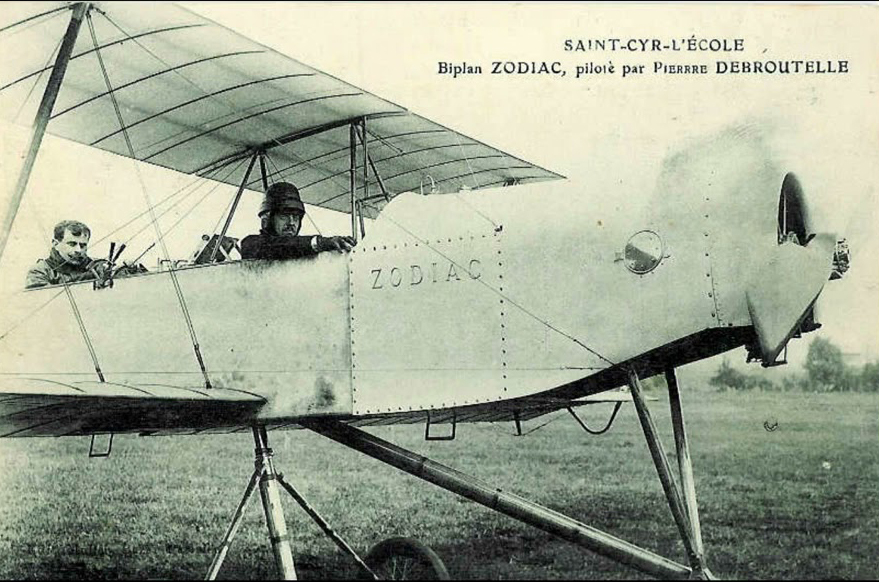
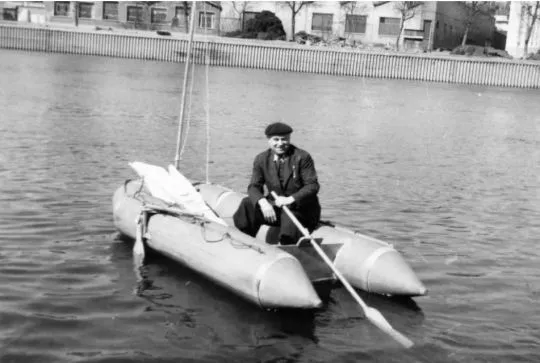
Founded in 1896, Zodiac at that time produces balloons and small airships for civilian use. Debroutelle obtains both his balloon and airplane pilot licenses (in 1912), just as his employer is also beginning to take an interest in heavier-than-air flight. He becomes an instructor at the company’s airfield in Saint-Cyr-l’École, before starting to compete in the Anjou Air Circuit Grand Prix, at the controls of a Zodiac biplane. A mechanical failure ends his race, which is won by Roland Garros. The military takes an interest in this aircraft, and Debroutelle takes part in trials involving the dropping of gliding bombs at the Mailly camp in the Aube region. The First World War brings Zodiac a number of orders, but the post-war years require the company to find new outlets, particularly in aviation safety and rescue equipment. In the early 1930s, a heart attack brings Debroutelle’s flying career to an end. He then becomes a full-time inventor at Zodiac, devoting all his creativity to innovative projects under the increasingly attentive eye of the armed forces. From 1934, he works on a new type of inflatable dinghy, built using fabrics supplied by a Hutchinson subsidiary, also based in Puteaux. His decisive contribution lies in adapting to an inflatable boat the principle of dividing its envelope into primary and secondary watertight compartments, as used to ensure the safety of an airship. The complexity and aviation-grade engineering of this design set it apart from the relative simplicity of rival inflatable craft at the time. In 1937, he refines this concept further with a new prototype for the French Navy, which is looking for a craft capable of carrying torpedoes. After a series of improvements, the “Zodiac” inflatable dinghy is born and is patented on August 10, 1943. Its lateral flotation tubes, tapering to points at the rear, are not unlike the traditional lines of certain airships.
In the end, Debroutelle adopts an original configuration, with horseshoe-shaped flotation tubes and a rigid wooden transom that will become the brand’s signature and define the modern inflatable boat through to the present day. A wooden floor also contributes to its overall rigidity.
Alain Bombard’s experience brings the inflatable boat to the wider public
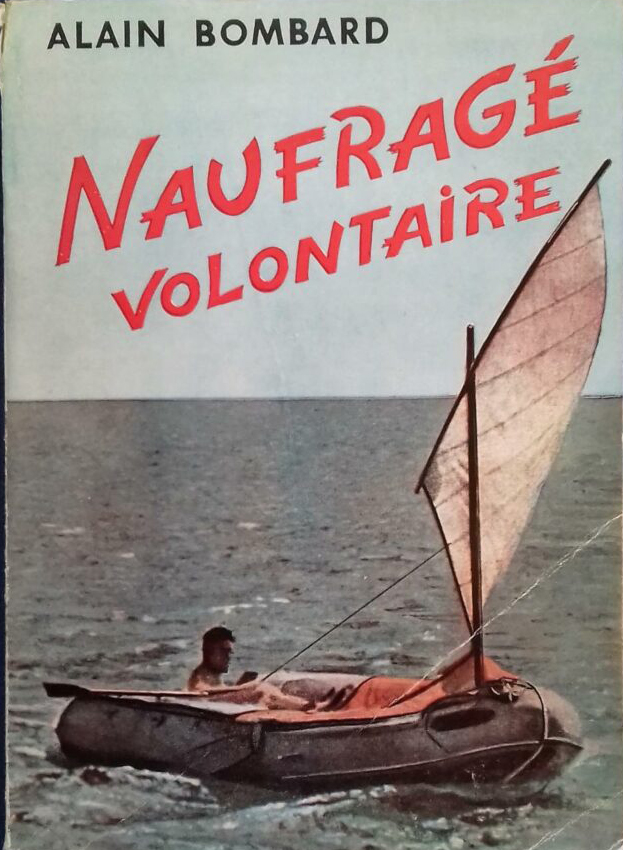
In 1951, Alain Bombard (1924-2005), then a biology intern at the hospital in Boulogne-sur-Mer, is called upon after the loss of a fishing trawler that claims 43 lives. This tragedy will shape both his future as a doctor and his research into survival in the event of a shipwreck. The following year, at the age of 27, he embarks on an extraordinary challenge: to feed himself exclusively from the sea while crossing the Atlantic, in order to prove that shipwreck survivors can remain alive for several weeks on board a frail craft with no real protection from the elements. His voyage is well known. Zodiac supplies a 4.65m inflatable dinghy. On October 20, 1952, aboard L’Hérétique, fitted with an Optimist sail, Bombard leaves the Canary Islands and does not make landfall until 113 days later, on Barbados in the Caribbean. Weakened, thinner, but alive, the young biologist successfully demonstrates what everyone thought was impossible: obtaining enough food and drinking water without carrying provisions. Looking beyond this feat of human endurance at sea that continues to fascinate, Bombard also proves that a craft as seemingly fragile as an inflatable dinghy less than five meters long can cross an ocean without being punctured or suffering a dangerous loss of air pressure. In doing so, he gives a major boost to the development of new survival equipment and helps shape international safety regulations. By associating his name with that of the French company L’Angevinière, he creates a range that soon also enters everyday language as a term for any onboard life raft: a “Bombard”. But that is another story.
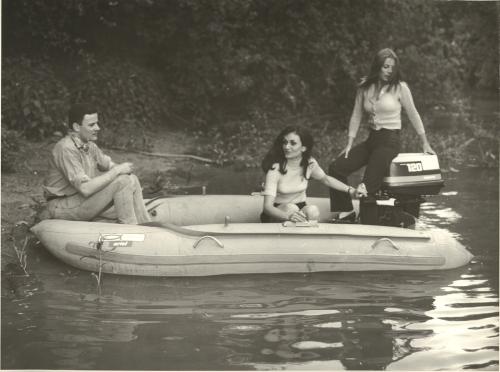
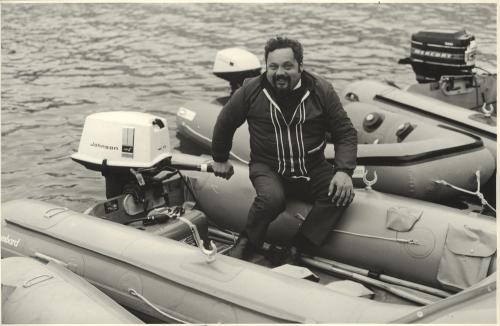
The Voluntary Castaway, the book recounting this crossing, is published in 1953 and will be translated into 15 languages. This improbable adventure, one of the defining stories of its era, encourages the adoption of inflatable craft by numerous civilian and military rescue and defense organizations, before winning over recreational boaters as well. The inflatable dinghy is increasingly viewed not merely as a tender or survival craft, but as a boat in its own right. For Zodiac, the success of Pierre Debroutelle’s boat design is now beyond doubt. Benefiting from extensive media coverage in newspapers, on radio and on the emerging medium of television, the simplicity and robustness of Zodiac’s boats will soon win over both the recreational boating market and the wider public. From the 1960s, new players appear, particularly in France, including Paul Brot and, above all, Tibor Robert Sillinger. In 1962, Sillinger creates the TR Sillinger brand, which is still highly respected among military and civilian users more than 60 years later. His exceptional personality and uncompromising entrepreneurial drive will lead him to hold several prominent national-level positions, including president of the Paris Boat Show, managing director of the French boating industry federation, and later national mediator.
The inflatable dinghy has long since earned its place in boating history thanks to its pioneers and heroes. In recent decades, its move upmarket, with increasingly sophisticated rigid-inflatable models, should not, however, make us forget its modest beginnings. For many devoted enthusiasts, it still remains synonymous with freedom, sporting camaraderie, adventure and discovery.
Gérald Guétat