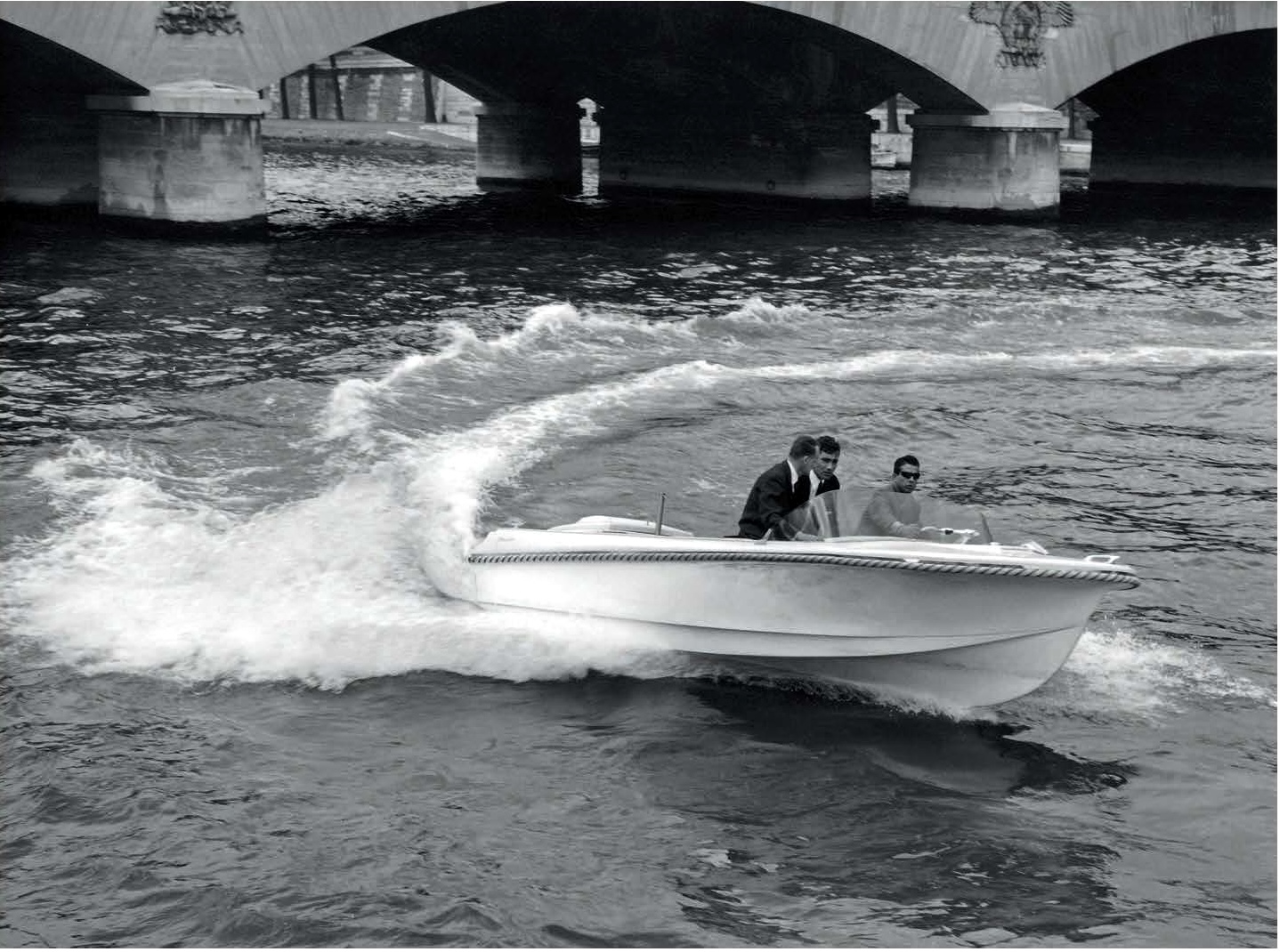
Domenico Rocca and his sons, the three musketeers of recreational boating
A father and his two sons transformed a modest builder of wooden canoes in Vitry-sur-Seine, just outside Paris, into France’s leading motorboat builder by developing, very early on, a range of boats, initially in wood, then establishing themselves as pioneers for the series production of fiberglass hulls.
As a young man, Domenico Rocca learns the craft of barrel-making in the Comino Valley, midway between Rome and Naples. He is 19 when Mussolini and his Blackshirts seize power in the Italian capital. The following year, in 1923, he and his wife Maria decide to leave their country for good and move to the eastern suburbs of Paris, where many of their fellow Italians have settled in successive waves since the end of the 19th century. Throughout the 1920s, they are among millions of Italians who settle in France as workers, in a country whose population has been severely depleted by the First World War. Domenico Rocca’s early years near Paris evoke an era when aircraft propellers are sophisticated pieces of engineering crafted from varnished wood. The talented young Italian immigrant finds his first job with Établissements Lucien Chauvière in Vitry-sur-Seine, a highly respected name in the demanding and rapidly expanding aviation sector. This firm mainly produces propellers, while also maintaining a small marine division that builds elegant river canoes. During this period, airboats – shallow-draft motorboats propelled by an aircraft-type propeller – are also in vogue, with their popularity fueled by the expansion of the French colonial empire. These craft are intended primarily to travel deep into the African interior along its great rivers. Chauvière builds prototypes for adventurous inventors attracted by the prospect of substantial government-backed contracts. For Domenico Rocca, whose exceptional mastery of propeller construction has already attracted attention, this is his first encounter with the world of boats — and he is immediately captivated by it. Before the end of the decade, an independent craftsman at heart, he has already left his job and set up his own woodworking shop in modest premises, without leaving his adopted town of Vitry-sur-Seine, to which he will remain loyal throughout his life.
1930-1950: From canoes to mahogany outboard dinghies
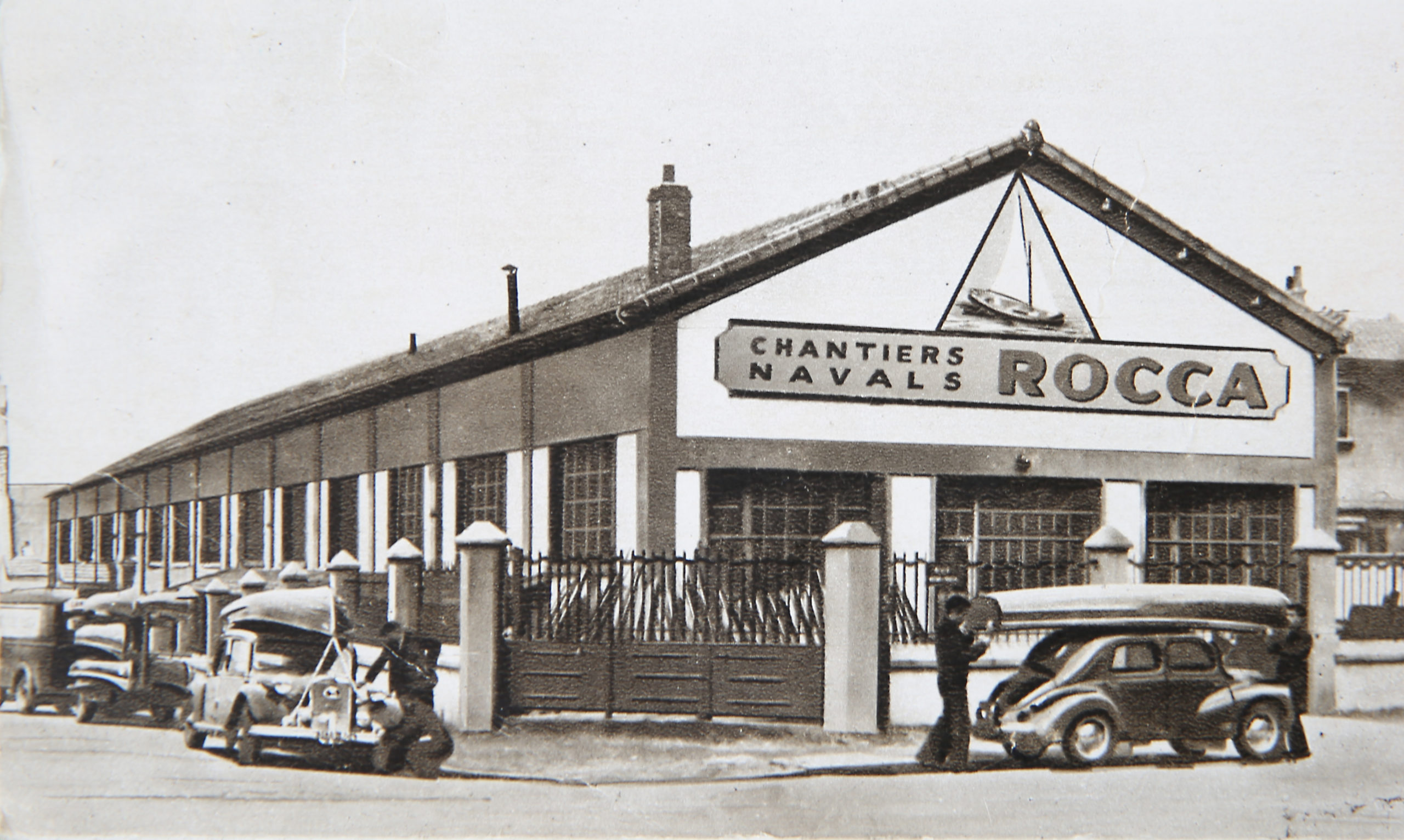
In the 1930s, canoe building supplements the woodworking commissions that support the Roccas, now a family of four after the birth of two sons, Louis and Oreste. After the Liberation, an average of three boats a day leave the workshop, which acquires a brand name and distinctive visual identity as early as 1947. By the end of the 1940s, around 20 people are working in premises that have already had to be expanded once. Domenico gradually expands the range, first by adding a sail and then by modifying the stern of a canoe to give it a transom and fit a small air-cooled, single-cylinder Monet-Goyon engine. This is the first powered Rocca, and customers want more. The first true dinghies soon follow, fitted with 10hp and then 22hp Lutetia outboards.
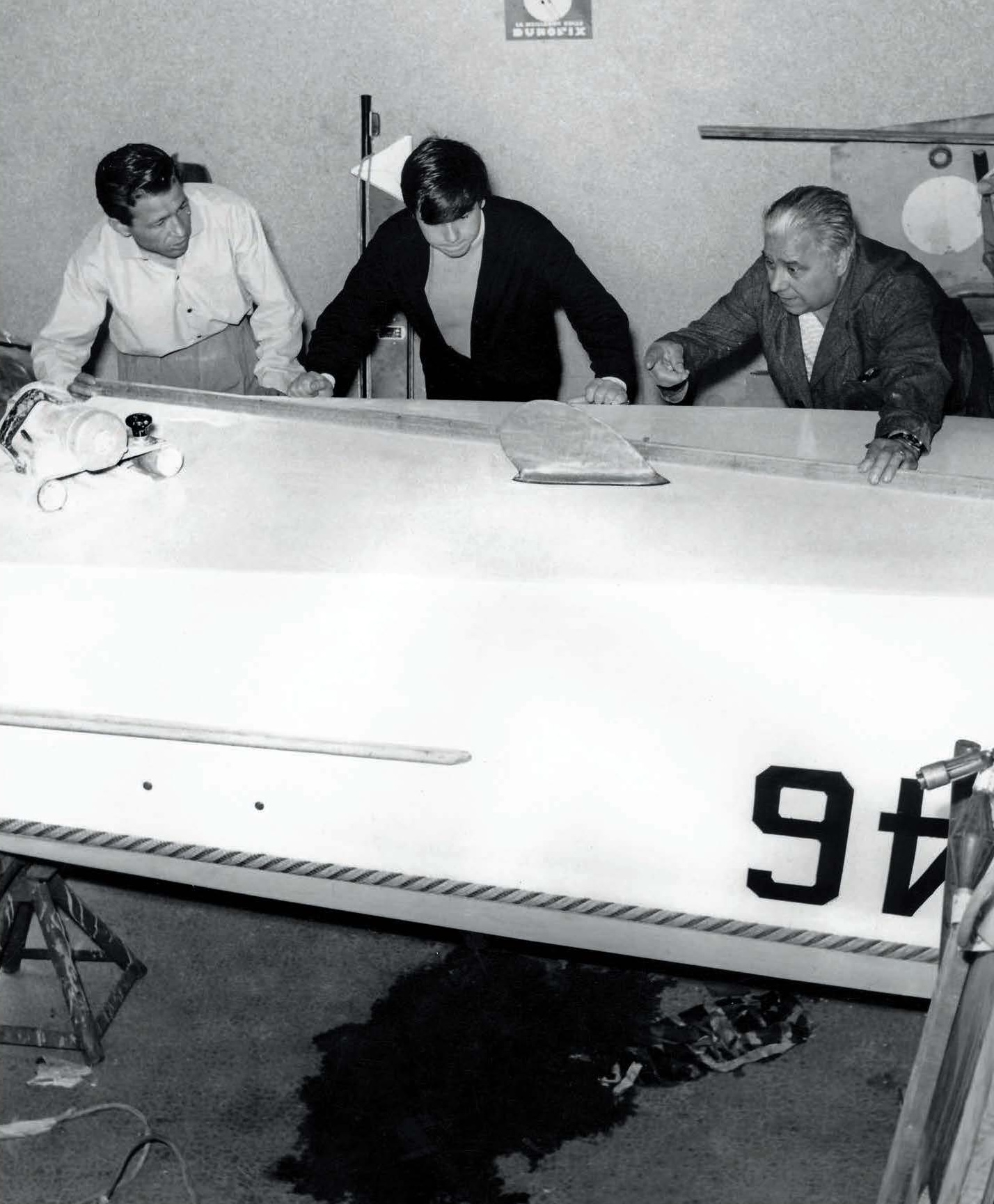
Rocca starts racing in 1950, with Oreste competing in the 500cc class. Most of Oreste’s competitors are racing Saever hulls. The young Rocca’s first race comes about only because a French Championship organizer persuades him to enter to strengthen the line-up. Against all expectations, Oreste wins, beating experienced drivers even though he does not yet hold a racing license. Despite this serious procedural irregularity, this first victory is allowed to stand. This success encourages Domenico to design a dedicated racing hull, which enables Oreste to set his first world record in the 1,000cc class in 1952. Father and son quickly become an unbeatable team. The Saever yard closes in 1953 and, although the business is taken over by Matonnat, it soon ceases operations altogether. The Vitry-sur-Seine yard seizes this unexpected opportunity and soon attracts a large share of Saever’s racing clientele. For affordable family boating with outboard power, the Rocca catalogue expands rapidly to include a number of wooden models up to 5 meters long, as well as its first cabin cruiser with a convertible top.
1950-1970: The irresistible rise of fiberglass
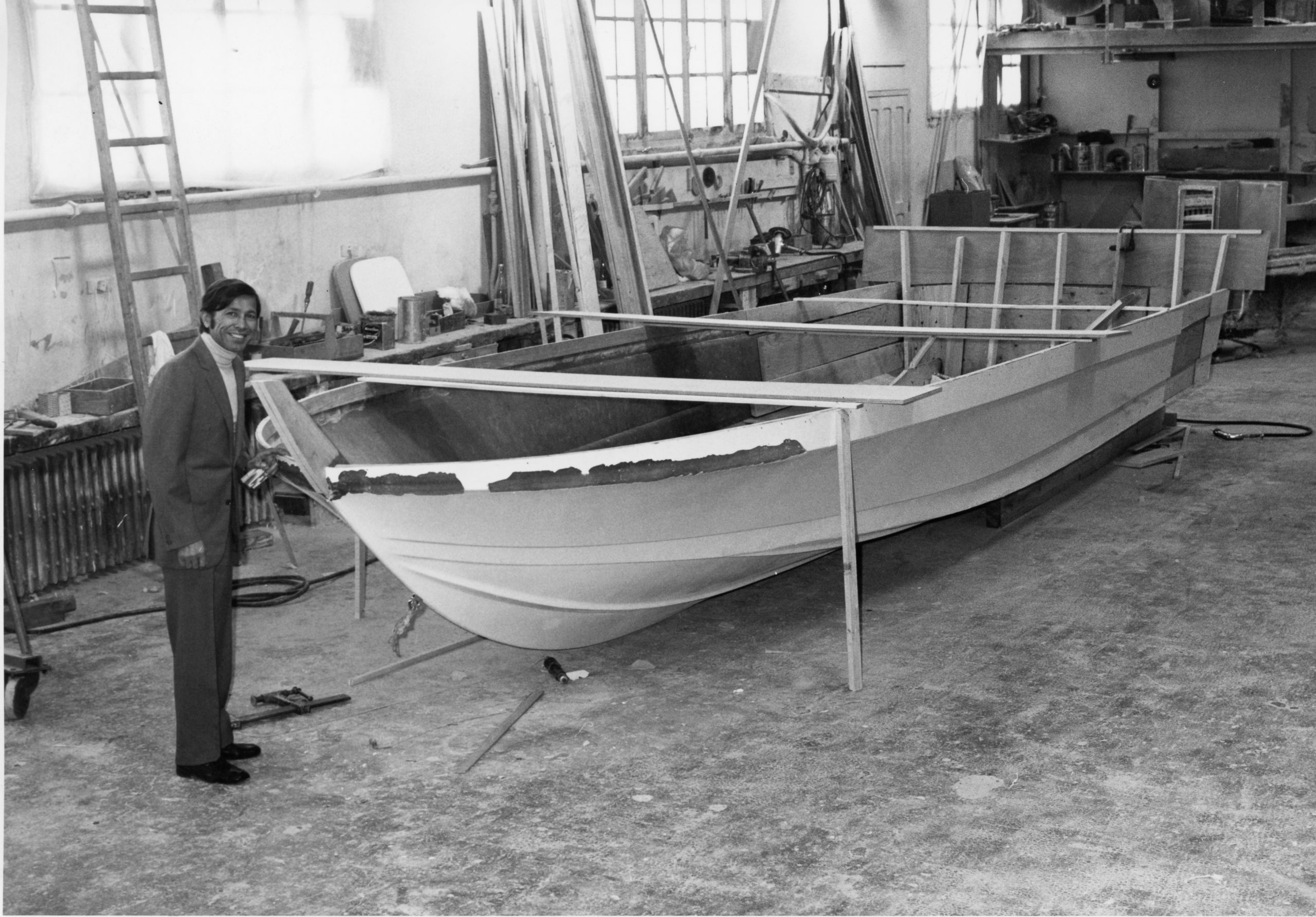
The Rocca yard is not immune to generational tensions. Domenico tries to resist pressure from his sons, Louis the technician and Oreste the racer, to experiment with fiberglass boatbuilding. But he eventually gives in and, in 1953, sets aside part of the workshop for Louis to explore this promising new technology. Louis’ first prototype hulls are not offered for sale, but are instead put through their paces in American-inspired water shows featuring maneuvering trials, ramp jumps, runs over small islets, passages through flames, and other stunts. His new fiberglass hulls withstand impacts that would inevitably have shattered their mahogany counterparts. Reluctantly, Domenico makes his decision: plastic has won. In 1954, the workshops are expanded to a total covered area of 4,000 square meters, and the first production fiberglass dinghies are hybrid designs that retain wooden decks. By 1957, the yard is already producing 1,500 units, with 300 cubic meters of wood, 15 tons of varnish and paint, 80 tons of resin, 70 tons of fiberglass cloth, and 5 tons of deck hardware… Every prototype, still personally designed by Domenico Rocca, is first drawn, then built as a scale model, and finally constructed full-size in wood to create the mold. Louis focuses on both construction techniques and the organization of production, where virtually everything is still done by hand, from laying successive layers of fiberglass cloth into the mold to saturating them with resin. Within 10 years, Rocca builds a sales network of 120 dealers in France, while also establishing a presence in Italy, Belgium, Switzerland, and Germany, enabling it to export more than 100 boats each year.
The yard owes part of its success to the brilliant racing career of Oreste, one of the pioneers of fiberglass-hulled powerboat racing. His impressive record across several fiercely competitive outboard classes does much to establish the Rocca name. Hundreds of trophies fill his office in Vitry: world speed records in 1953, 1955 and 1956, French Championship titles in 1953, 1955 and 1957, European Championship titles in 1957, 1960 and 1964, and victories in several Monaco Grand Prix classes in 1956, 1957, 1958, 1959 and 1960.
At the end of the 1950s, Oreste also performs spectacular powerboating feats as part of Pierre Bellemare and Jacques Antoine’s hugely popular television game shows Télé-Match and later La Tête et les Jambes, watched by millions of prime-time viewers. These regular television appearances will have a major impact on the popularity of the Rocca brand – and, more broadly, the growth of recreational motorboating as a whole – helped along by the colorful live commentary of Roger Couderc, a champion at captivating an audience.
Oreste is handsome and charismatic, yet remains unfailingly modest despite his victories and the yard’s success. He works closely with his brother Louis on developing the fiberglass models, serving as their highly effective test driver. He enjoys parties, luxurious American cars, and Italian sports cars, without ever neglecting his responsibilities within the company. And he is incredibly proud of his young son Patrick, who begins racing in his own right in 1962, thanks to an exceptional exemption from the licensing rules, which inevitably reminds Oreste of his own first steps.
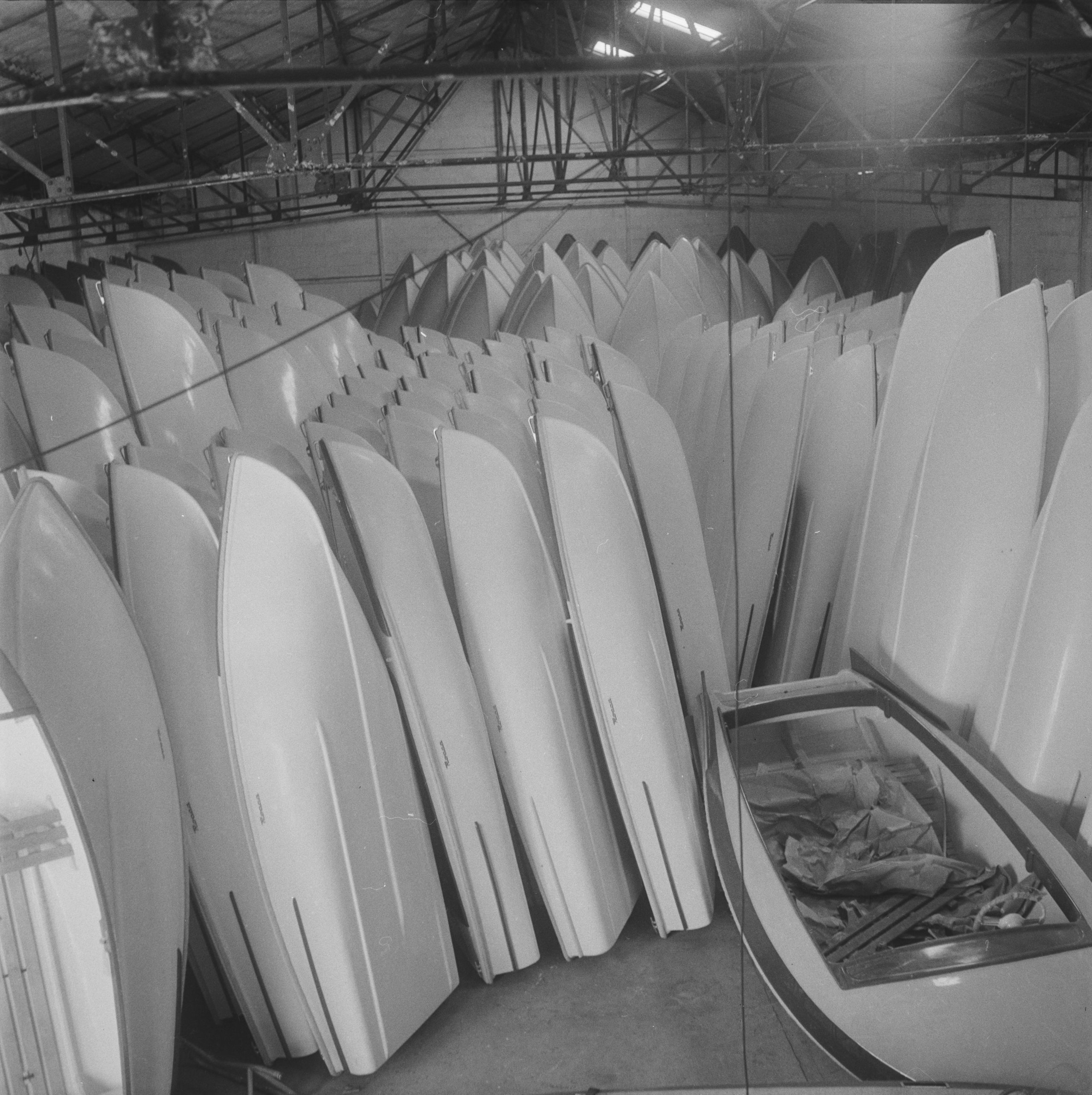
Between 1960 and 1963, the Vitry-sur-Seine yard employs around 100 workers and produces some 15 hulls a day. By February each year, 500 to 600 completed boats are already in storage to be ready for the orders that will come in during the spring and summer season.
In 1963 alone, the Roccas deliver more than 3,000 fiberglass units, from canoes to the San Remo, making the company the largest recreational boatbuilder in France. These are the core years for the yard’s development, requiring more production space, as well as larger showrooms and offices. The 38 models from the catalogue can no longer fit inside the existing showroom. In 1965, Oreste secures the permits required to launch construction of an ultra-modern, avant-garde building offering 1,500 square meters of space over three levels, an exceptionally bright piece of architecture that perfectly reflects the optimism of the period. It is inaugurated in 1966 by Roland Nungesser, a future Minister for Youth and Sports, symbolically just after the Paris Six Hours event, with all 170 representatives from across the Rocca network invited to attend.
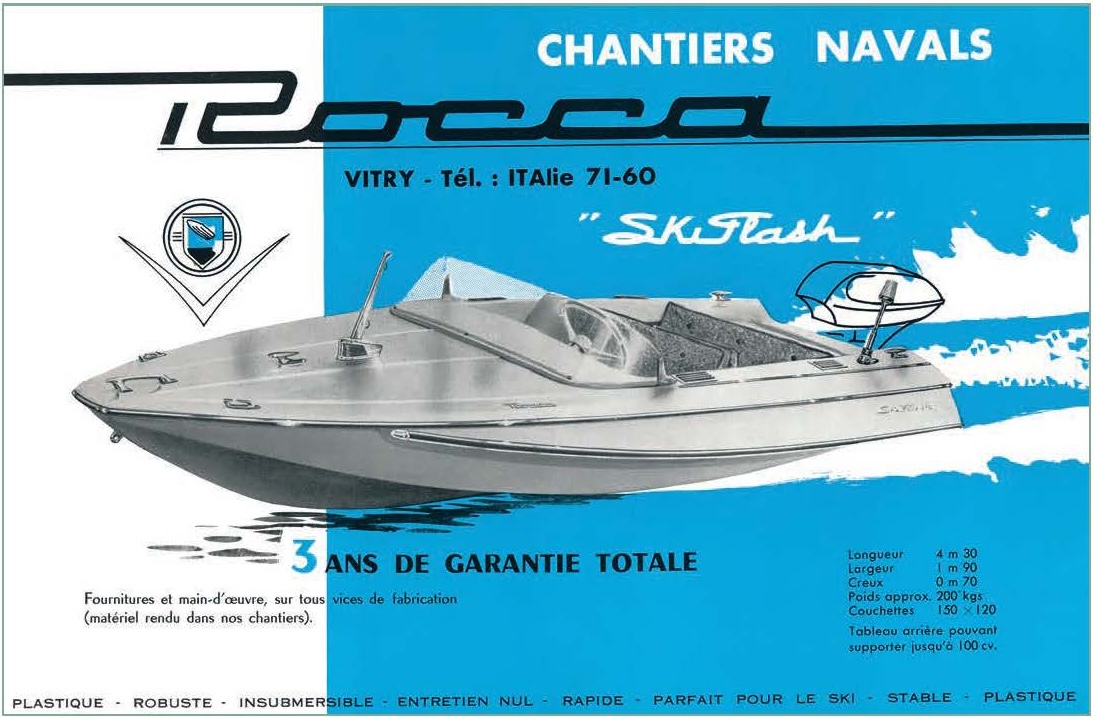
Among the many models that underpin the brand’s commercial success, three in particular mark the definitive shift to fiberglass, and all three have a strong focus on water skiing, then at the height of its popularity. The agile and rapid 4.30m Ski Flash, inspired by an American model, will remain in production from 1964 to 1970. The 5.20m San Remo also enjoys great success in the mid-1960s, with its two small tailfins extending toward the transom and recalling the flamboyant American cars of the time. The 4.35m Sabre, meanwhile, features a well-designed V-hull and a carefully finished interior for a boat in this relatively modest class. Offering the fiberglass in white or blue allows Rocca to appeal to a broad range of customers.
1970-1980: A decade of change
Still determined to offer an extensive range of models, Rocca also brings the major design trends of the 1970s into its boats, reflecting influences seen in furniture and automobiles, as well as boat design. These years mark a turning point in the history of industrial companies, characterized by profound technical, aesthetic and cultural changes, not to mention the upheaval caused by the oil crises of 1973 and 1979. The design language of the “seventies” is instantly recognizable, dominated by angular lines, bright colors and tinted glazing.
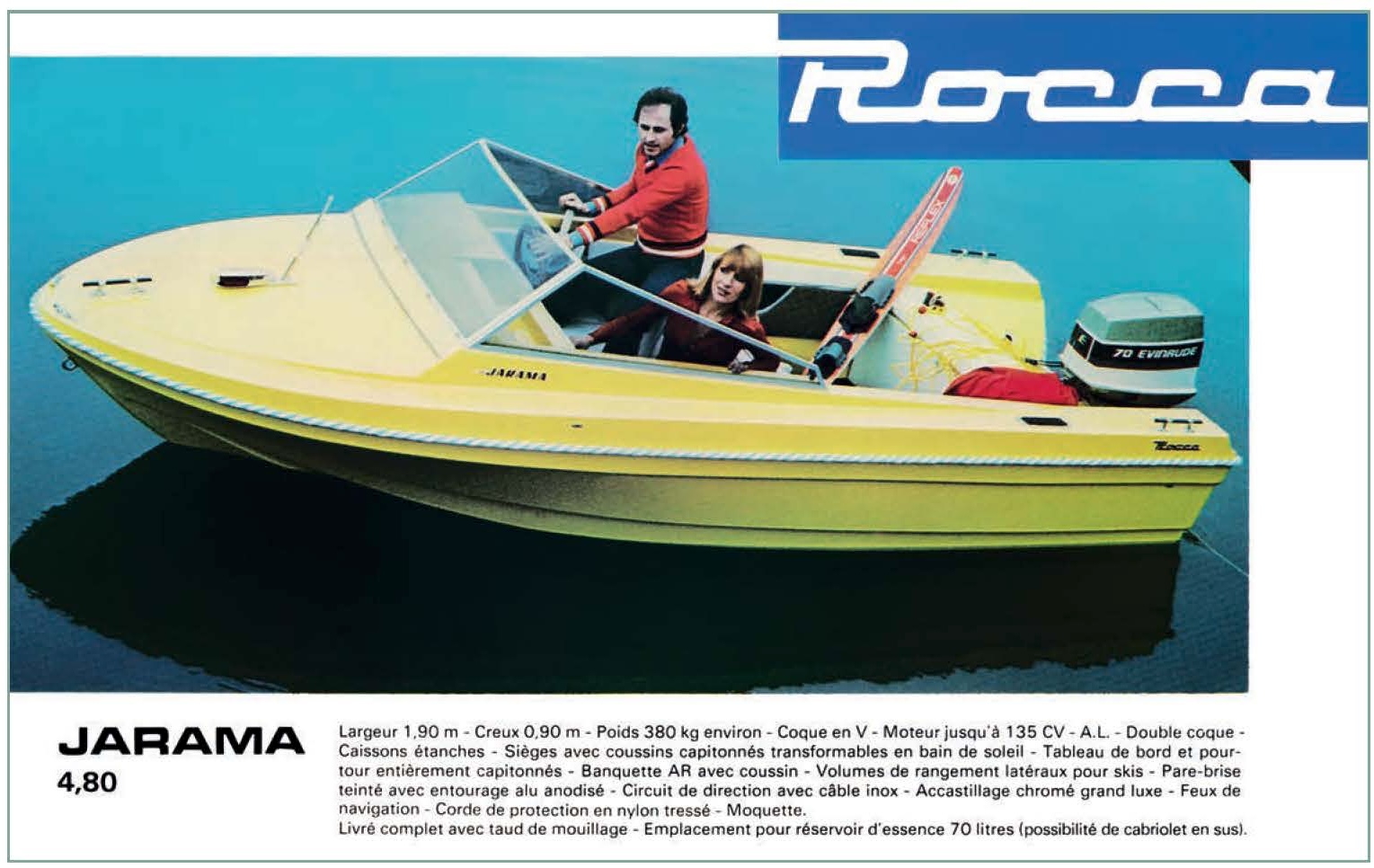
In Vitry-sur-Seine, outboard models still make up most of the range, although inboard versions are by no means neglected, particularly now that Z-drives or sterndrives have made it less expensive to install engines that are often taken from the automotive industry. For instance, the 4.75m Impala is offered either with an outboard or with an inboard engine coupled to a sterndrive. The continued growth of recreational boating is accompanied by a gradual move upmarket as more affluent customers enter the market. The new flagship models of the 1970s are called Cougar, Comet and Mirage, continuing to develop the concepts from earlier models with lengths of less than 5 meters. More ambitious, the 6.80m Islero is a dynamically styled inboard cabin boat, while the more accessible 4.80m Jarama also draws on the brand’s sporting reputation. To further strengthen sales and fire the imagination, Oreste readily borrows model names from Lamborghini. However, by the turn of the 1980s, Rocca is struggling to renew its range at a time when American imports are bringing a steady stream of new ideas, while other French yards such as Jeanneau and Bénéteau continue to make steady progress.
1980-1995: A brand in decline as competition intensifies
The boating sector as a whole is also hit hard by a succession of oil, real estate and financial crises. The momentum that has long held the family together begins to fade as well. Domenico dies in 1983, by which time Oreste is running the company. In 1985, despite increasingly difficult conditions, Rocca is able to announce the delivery of its 100,000th boat. But Oreste steps down from management in 1988, just as the first prospective buyer comes forward in an attempt to revive the business. The attempt is unsuccessful. The yard enters court-supervised restructuring in 1990 and is sold to the Sagir property group the following year, before filing for bankruptcy in 1991. The Rocca name still retains some potential value, but now enters a period of geographical and financial uncertainty that takes the brand as far as La Rochelle before it disappears altogether. Accor Composites fails to revive the brand in 1993, then the British Duncan group makes its own attempt before giving up in turn in 1995. The Rocca name then becomes part of the cherished history of vintage motorboating enthusiasts. It is not until 2021 that the red logo reappears at the Paris Boat Show with the launch of a new composite San Remo, a 7-meter open boat with outboard power, built by the Tunisian yard Faryacht and distributed by Stéphane Jaubert. At the time, attempts to revive once-famous names that had faded from view are relatively common in both the boating and automotive worlds. But success is never guaranteed. Times change, and no adventure can ever be repeated in quite the same way. Rocca therefore remains an enduring example of exceptional family success, carried by the growth of the Glorious Thirties and the drive and ambition of Domenico, Louis and Oreste. In the black-and-white memories cherished by powerboating enthusiasts, Oreste, in particular, is unlikely ever to hang up his champion’s helmet.
Gérald Guétat
Further reading:
Classic powerboating enthusiasts will enjoy Valère Gaussen’s comprehensive and richly illustrated book Rocca, la légende française du motonautisme, written in collaboration with Patrick Rocca in 2016 and published by Sophia Éditions (www.sophia-editions.com).