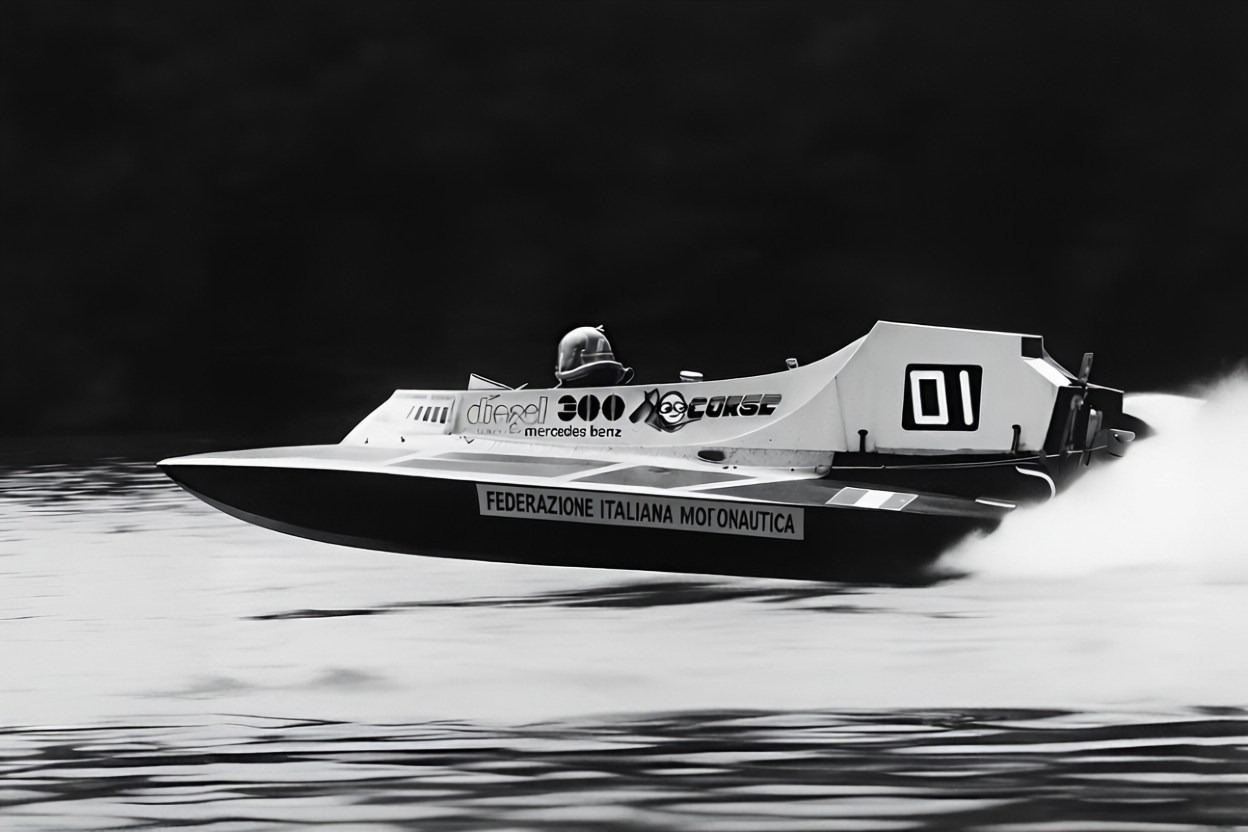
Fabio Buzzi, The power of destiny

Fabio Buzzi rarely strayed far from his native province of Lombardy, except to head out and conquer, in offshore competitions, no fewer than 52 world titles, 22 European titles and 27 national championships, alongside more than 50 different world records. His home region of Brianza, between Milan and Lecco, has a long tradition of creativity. This world-renowned center for contemporary furniture design boasts cutting-edge companies in a number of areas, at the heart of a particularly dense network of specialist subcontractors. At the foot of the mountains, between hills topped with monasteries and cypress trees, small, ultra-modern workshops operate out of buildings that are designed with the same care and attention to detail as the products leaving them.
It is in this inspiring environment that, in 1971, the young Buzzi, back from the Polytechnic University of Turin with his engineering degree, sets up his first studio, which is already called FB Design. From that moment on, the Ingegnere shows a talent and courage that are widely admired. In 1978, he designs, builds and pilots an innovative small fiberglass-balsa sandwich catamaran to set his first world record. His entire career seems to be guided by his pioneering choices, determined to drive progress with hulls, materials, diesel engines and transmission systems to deliver high performance.
Five decades later, the scale of the yard that bears his initials has changed a lot, but the passion behind it remains the same. The minimalist facade of FB Design’s headquarters is flanked by a soaring metal and glass wing, as tall as a church, where several legendary racing machines hang suspended on cables, as if in flight. Beneath this futuristic aviary, Fabio Buzzi reigns over a world that is both sleek and vibrant with color, furnished entirely with Tecno designs from Sir Norman Foster.


Speed limit of 3 km/h
Huge tables are covered with plans, models and sketches, surrounded by stacks of files. If Leonardo da Vinci had not emigrated to Clos Lucé, he would surely have loved to return a few centuries later to work here… Yet behind the almost monastic discipline, this is a family-run operation in the finest Italian tradition. The Ingegnere’s wife and daughters share with him the management floor, where two dogs and a collection of parrots – the company’s emblem – roam freely. From the moment you pass through the gate, the tone is set with a road sign announcing a speed limit of 3 km/h: “Slow: bassets crossing”. On the office floors, staff have grown accustomed to the sometimes shrill calls – “Ring, ring… Hello! Hello! Don’t hang up!” – repeated by the chattiest of the exotic birds, who seem as much at home here as at Captain Haddock’s Marlinspike Hall in The Castafiore Emerald. Serious work and playful humor coexist seamlessly in this place.
Around the courtyard linking the construction halls, vast doors reveal gray or sporty hulls at various stages of completion. In other workshops, more hidden and even secret, the famous transmission systems are developed behind frosted glass. Some 50 people work on site, like a campus dedicated to advancing powerboating technology, supported by a discreet test base on Lake Como, around 10km away, completing this ever-evolving private center of excellence. With a record of achievements like this, its effectiveness speaks for itself. Yet the founder of this unique enterprise would readily say that he was a pilot only out of necessity, although he acknowledged the sheer pleasure of taking on challenges and racing along at high speeds. But it was more than this. When not at the helm, Fabio Buzzi, fluent in French and a great admirer of French culture, was a true bon vivant, a lover of good food with a hearty appetite.
From the master’s hand
Racing is still the most formidable trial that any boat can face. Fabio Buzzi preferred the open sea and endurance events over circuit racing, even though he once finished second in the 24 Hours of Rouen: “My job is not to be a pilot, but to use racing to refine my innovations and to sell these technologies to major industrial groups like ZF, FPT or MTU”. He is behind the creation of Seatek, which revolutionized high-performance diesel propulsion in the 1980s, and will always remain loyal to this truly seaworthy fuel. He also collaborated for many years with Sunseeker, to name just one brand. Innovation always begins with a blank page, where a single stroke of the pencil gives rise to an idea that plans, calculations, prototypes and water trials will then validate… or not. He continues to open up more fields for exploration, taking on a range of challenges, from composite materials to cockpit design and propeller efficiency. He filed his first patent in 1980, and today, more than 50 of his inventions are used in various applications, including engines and transmission systems, as well as pressure-molded hull construction and suspended seating ergonomics, a crucial factor at speeds over 70 knots in rough seas, drawing on his racing experience.
From the early 2000s, Fabio Buzzi also embraced the vital importance of investment, even if this meant taking risks that seemed audacious given the size of his company: “I was fascinated by the potential of digital technology. For someone who had always designed and built his boats on wooden mock-ups, using nails, screws and a plumb line, this leap forward was a decisive turning point. While a few major groups were just starting to install giant milling machines capable of producing full-scale models with near-perfect accuracy from every angle, I formalized my relationship with Teresa – my new mistress – a magnificent five-axis milling machine, measuring 24 meters by six…”.
Buzzi also had his favorite racing models, such as Gran Argentina and the unbeatable Cesa, a winning machine that became the most decorated boat in offshore history, across more than 25 years of competitions. Launched in 1985 as Rolly-Go with four Iveco engines, it became Luchaire in 1987, refitted with four state-of-the-art Seatek units. It secured legendary status by winning the 1988 and 1989 world championships, piloted by Stefano Casiraghi. In 1990, renamed Tecno, this pure-bred finished third in the Venice-Monte Carlo race. Later found, almost miraculously, in Florida, it was fully restored in 2007. On board, King Carl Gustaf of Sweden became, at 178 km/h, the fastest monarch on the water, dethroning Juan Carlos of Spain, who was “limited” to 140 km/h in his FB42 RIB, also built by FB Design! With his venerable monohull, still fitted with Fiat engines like the original model, Fabio Buzzi went on to win the world-famous Cowes–Torquay Classic in 2008, and again in 2010 – an achievement he characteristically downplayed with his usual humor: “This might also mean that nobody else made much progress in all these years!”

The fatal charm of La Serenissima
You never forget your first time. Buzzi makes his racing debut in 1960 in the Pavia-Venice event, using his older brother’s papers because he is still too young to get a license. This was the start of a long love story. In 2011, he writes with emotion, in his book Progettare il futuro: “The course of the river linking two great historic cities literally takes me in its arms, like the sinuous movements of a passionate dance. And I feel this attraction growing stronger and stronger; my fascination with Venice, its lagoon and its canals continues to increase as the years go by. Even today, after a lifetime spent battling waves on every sea around the world, I cannot do without the noble composure of the great river, which forces me to struggle against the deceptive calm of its currents. I have almost always mastered it, in 34 participations in this race, forging a wonderfully intimate relationship with it. With its countless islands barely rising above the water, it always seeks to ensnare you. Once, I struck one of these islands at such speed that I crossed it from one side to the other, carving a deep furrow without running aground. They wanted to call it the Buzzi Canal…”.
After many more adventures, in March 2018, he shattered his penultimate world record, this time for outright speed in the diesel category, on his home waters off Lecco. From this event, widely promoted in the media by its partner Fiat, the world will ultimately remember less the performance of the single-seater catamaran designed and built by the maestro (277.515 km/h) than the age of the captain: 75.
And then there is Venice, once again and always, never far from his horizon. In 2019, his attempt to break his own 22-hour record for the run from Monaco to the City of the Doges, rounding the peninsula via the Strait of Messina, is a success in 18 hours and 30 minutes. On September 17, around 9pm, the race officials watch the new record being set in the darkness, expecting the boat to slow down and return to them. But it continues at full speed, and strikes, head-on, a low, unmarked stone embankment forming part of the lagoon’s breakwater system. Of the 4-man crew, only Mario Invernizzi, who is thrown clear, survives and later speaks of the total shock of the impact. Luca Nicolini, Erik Hoorn and Fabio Buzzi are killed instantly. A wake closes behind them. The fate of the last independent pilot-constructor will remain forever intertwined with the legendary city, where he dreamed of settling soon after, to complete his life’s work.
Gérald Guétat


Fabio Buzzi (1943-2019): A life at full throttle
1943: Born in Lecco, Lombardy.
1960: Began racing in the Pavia-Venice raid event.
1970: Graduated in mechanical engineering from the Polytechnic Institute of Turin.
1971: Founded FB Design and began experimenting with composite hulls using sandwich-core construction.
1977: Began to focus his research on diesel propulsion and improving propellers and transmission systems.
1978: First European offshore Class 3 championship title and first diesel world speed record on a closed circuit at 191.58 km/h.
1980: Filed his first patent, the start of a long series of more than 50 inventions.
1981: New innovation: launch of the first sandwich-construction offshore hulls, challenging the dominance of aluminum boats.
1982: Start of an extraordinary run of Italian, European and world offshore diesel titles in Classes 2, 3-4 liters and 3-6 liters through to 1988.
1984: World diesel unlimited class speed record.
1985: World diesel records (speed, endurance, 1 hour)
1986: World champion in Classes 1, 2 and 3-6 liters. Founded the firm Seatek.
1987: World champion in the 3-6 liters class.
1988: Diesel world speed record. Class 1 world champion.
1989: Class 1 world champion.
1992: Diesel world circuit record at 252.27 km/h.
1999: Miami-Nassau-Miami record at 156.12 km/h.
2001: Monte Carlo-Venice record at 60.20 km/h and Round Britain record at 81.79 km/h.
2004: Winner of Pavia-Venice with an average speed of 198 km/h.
Monte Carlo-Venice record at 88.44 km/h and Tampa-Miami record at 135.49 km/h.
2008: Winner of Cowes-Torquay.
2010: Winner of Cowes-Torquay.
2016: New Monte Carlo-Venice record at 94.43 km/h.
2018: New absolute world speed record for a diesel engine at 277.515 km/h.
2019: New Monte Carlo-Venice record at 98.82 km/h.

