50 years ago Transat 76 : a new world
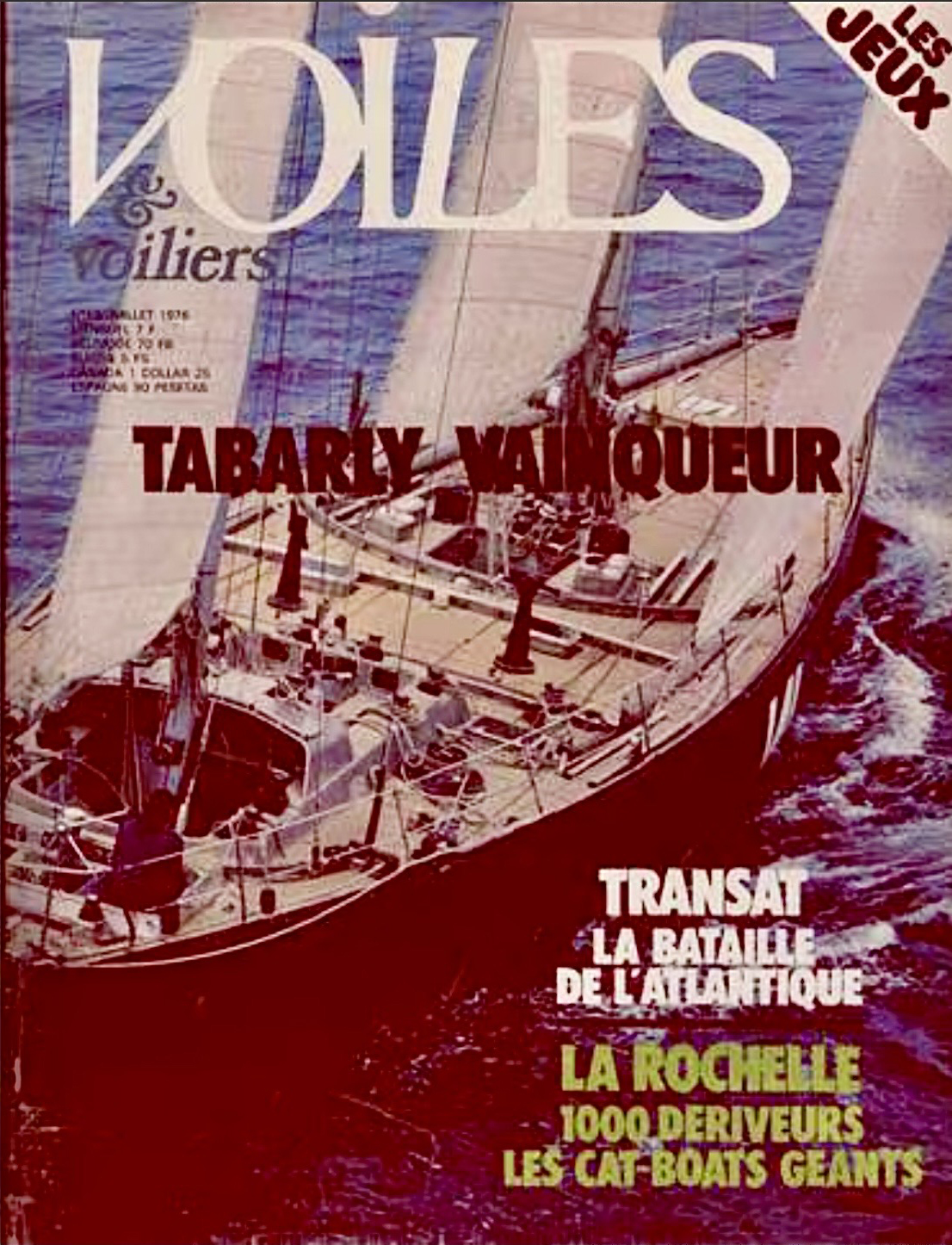
“TABARLY WINS” – On June 26, 1976, Voiles et Voiliers, then France’s leading sailing magazine, appears on newsstands with an unequivocal front-page headline, accompanied by an aerial photograph of the great monohull Pen Duick VI.
Magic! Magnificent! Extraordinary! Certainly.
There is just one small problem… Not only has Éric Tabarly failed to round the curious Brenton Tower, which marks the finish of the third Observer Singlehanded Trans-Atlantic Race (OSTAR), at the head of the fleet of 125 yachts that set out from Plymouth, England, three weeks earlier, but… no one has heard from France’s most famous sailor for days!
For three agonizing days, the country’s first monthly magazine devoted entirely to sailing remains on the newsstands while anxiety grips the nation, with the prophets of doom already announcing the hero’s disappearance at sea, forcing his loyal second-in-command, Olivier de Kersauson, to declare his confidence on the front page of France Soir.
50 years later, in the age of Starlink and live onboard video, of the VesselFinder and MarineTraffic apps, which show the real-time position of virtually all the boats around the world, and of digital charts and astonishingly precise route-planning tools, it is hard to remember what ocean crossings were really like in those days.
At the end of June 1976, one of the great figures of the sea was missing, and an entire nation was consumed with anxiety, like those Breton women in traditional headdresses standing at the end of the quay, waiting for the return of a husband, a father, or a son. 50 years ago, in terms of offshore sailing, a sailor like Tabarly was closer to Christopher Columbus than we are today to the immortal skipper of the Pen Duick yachts.
Fortunately, as fortune favors the bold, in the early hours of June 29, the giant of solo ocean racing finally emerges through the fog in Narragansett Bay. He brings the agonizing suspense to an end, and wins his second single-handed Transat. In the process, the hero also saves Voiles et Voiliers from one of the most embarrassing false headlines in sailing journalism. Next year will mark 100 years since the Parisian daily La Presse boldly announced the triumphant arrival of Nungesser and Coli in New York. In reality, the two aviators had disappeared without trace during their attempted flight across the North Atlantic.
In June 1976, Tabarly’s unexpected victory creates a media earthquake. This remarkable man emerged from nowhere to confound every prediction.
Before the start, the gurus of offshore racing questioned whether he could possibly handle alone a thoroughbred ocean racer designed for a crew of 14. The radio commentators and self-appointed experts could not see how his conventional 22-meter racing monohull stood the slightest chance against rivals that were, at least on paper, in an altogether faster league. Among them were the 20-meter catamaran Kriter III, formerly British Oxygen, a true sailing missile and recent winner of the Round Britain Race; the trimarans Spirit of America and Three Cheers, capable of phenomenal bursts of speed; and the 39-meter, three-masted ITT Oceanic, formerly Vendredi 13, which had missed out on victory by the narrowest of margins four years earlier. And these formidable challengers were only the beginning. Even if a lucky break in the weather favors him over these speed machines, how can such a reckless man hope to get the better of the enormous Club Méditerranée, a 72-meter, four-masted giant aboard which a young daredevil named Alain Colas confidently declared that the race was as good as won? Had he not proclaimed:
“Victory belongs to me by right!”
To give this fifth single-handed “Transat” – the only race of its kind at the time – its truly Shakespearean dimension, how can we not mention the fact that Colas also intends to “kill the father”, to snatch the hero’s crown and laurels, and to replace, both on the cover of Paris Match and in the hearts of the French public, this omnipresent Tabarly who had converted a nation of landlubbers to the mysteries of sailing?
Colas had his arguments. He had bought the Pen Duick IV, the forerunner of the multihull wave that would sweep through ocean racing, from its original owner, a mere naval officer who could no longer afford to keep her. Even more cruelly, aboard this rocket ship imagined by Tabarly, he had achieved two feats: winning the 1972 Transat, after his former master had failed in the previous edition at the helm of that same flying machine, and completing the very first solo circumnavigation of the globe in a multihull, through the Roaring Forties.
So, what possessed this talented, fiery young man, sometimes given to grand declarations, to return to the 1976 Transat aboard a four-masted ship? When defending a title won so convincingly aboard a trimaran as innovative as it was visionary, logic suggests returning with an even more formidable machine, benefiting from every advance made over the previous eight years in these sailing dragonflies. In 1976, as we have seen, the Transat fleet includes several three-hulled prototypes that positively ooze speed.
But logic is rarely romantic. It demands a deep understanding of the sea, something the skipper from Burgundy, who had discovered sailing less than 10 years earlier in Australia, still did not fully possess. Unlike the legendary master of the oceans who he is determined to eclipse.
In truth, Colas never quite got over winning in 1972, but, above all, how close he came to losing: with his 39-meter, three-masted “cigar,” still far from fully developed, Jean-Yves Terlain finished just a few hours behind him in Newport.
This was… perfectly logical! The Transat route, from Plymouth to Newport, requires competitors to cross the North Atlantic hard on the wind and against the seas. Yet the multihulls of the time still suffered from a major weakness: they struggled when sailing to windward. By contrast, their single-hulled rivals from this period were all designed to excel on this point of sail. A basic principle of naval architecture states that a hull’s maximum theoretical speed is directly related to its waterline length. The longer that length, the higher the hull’s critical speed. That was Terlain’s reasoning with his vast Vendredi 13.
Incidentally, it is worth noting that this young naval architect followed the Transat rules to the letter, while perhaps stretching their original spirit.
Two Englishmen, conquerors of the gloriously useless, had dreamed up the whole affair at the end of the 1950s. It could be summed up in a simple formula:
“One sailor, one boat and the ocean”.
There was a start line and a finish line, but almost everything else was left to the competitors. And so, as each race came around, the organizers saw an extraordinary procession of creations arrive, at times resembling a floating inventors’ fair: junk-rigged monohulls, multihulls with improbable structures, tiny nutshell-like craft in which determined eccentrics attempted to reinvent the wheel… or rather, the paddle wheel. Whatever the case, enthusiasm for this celebration of freedom continued to grow.
To such an extent that, in 1976, no fewer than 126 yachts of every conceivable size and shape crowd into the grimy basin of Millbay Dock in Plymouth. Or 125, to be precise, because Colas’ sailing leviathan is simply too large to fit inside. The same number will eventually start the race, after the organizers refuse permission for the skipper of a tiny sail-powered launch to attempt the crossing.
So, four years after his victory, Colas pushes Terlain’s reasoning beyond the limits of the reasonable, perhaps even beyond those of rationality. Since he had almost lost to a 39-meter single-hulled vessel, all he has to do is return with a monohull that is almost twice as long to secure victory. Before the starting cannon has even fired.
However, we should remember that Colas had begun his offshore racing life with a deep mistrust of multihulls. While fumbling through his first maneuvers aboard proud racing yachts in Sydney Bay, he wrote:
“In Australia, I had developed a strong prejudice against multihulls, trimarans or catamarans, several of which had been lost in dramatic circumstances”.
But that was before he bought Pen Duick IV and brought her back to France from Polynesia. Only fools never change their minds. Ironically, Terlain, his rival from 1972, had traveled the opposite intellectual path: abandoning his endless monohull “cigar” in favor of what was considered to be the world’s fastest 20-meter catamaran…
A gifted communicator who understood the growing importance of sponsorship, Colas secured the backing of Club Méditerranée along with the support of virtually the entire French regional press. He was not merely the favorite, but the expected winner. “Victory belonged to him by right”…
Admittedly, with its 250 tons of displacement, the sail-area-to-weight ratio of his monster was far from dazzling. Tabarly himself even said that this boat contributed nothing to naval architecture:
“I never thought it could be a very fast boat across the Atlantic (…) the eight sails one behind another, with the forward sails blanketing those behind, simply prevented it from sailing efficiently to windward”.
In addition, the deck hardware of the period struggled to handle these sails, which weighed several hundred kilograms. More worrying still, during a mishandled maneuver at La Trinité-sur-Mer a year earlier aboard his Pen Duick IV, by then renamed Manureva, Colas had almost torn off one of his feet. Watching him limp across the deck of his aircraft carrier inspired admiration for his courage, but also concern for his recklessness.
His madness? The Transat organizers were certainly alarmed when they discovered the giant’s entry. The founding fathers of the greatest sailing race ever invented had clearly never anticipated anything like this. It was not so much that Club Med distorted the competition, but that it represented a danger to navigation. Especially in the intense traffic at the exit of the English Channel, with only one crew member aboard, who was still recovering from a serious foot injury. They therefore imposed on Colas an additional qualifying course that was three times longer than the original one. He protested, but had no choice but to comply…
For his part, Tabarly had no choice either. Orphaned of his trimaran, he resolved, to the astonishment of his loyal followers, to enter the race with Pen Duick VI, a formidable ocean-racing machine… with a crew of 14 men to handle her.
Tabarly had therefore done what Tabarly always did. During a stopover in Rio, he had taken his large ketch out alone. “Just to see”. He saw, and he could do it. He had devised equipment of his own to hoist his spinnakers without them becoming tangled in the rigging, and to lower his genoas without them falling into the water. With his extraordinary seamanship and unshakeable faith in himself, he dared to appear on the starting line.
This 1976 Transat was monstrous. While Europe suffers a drought and endless heatwaves, the North Atlantic sees “exceptional” weather conditions: five depressions sweep across the Transat route. The associated storms cause considerable damage: boats break apart, skippers break bones. One trimaran disappears without trace, and a monohull is found with no one aboard. Half the fleet retires.
Deprived first of his autopilot and then of his radio, Tabarly crosses this hell and is first to reach the finish line. This is an incredible achievement, superhuman. Colas? He is forced to put in to Newfoundland to replace broken halyards and lost sails. He sets off again 36 hours later without any great urgency, convinced that he has lost his bet: has the media not announced that Tabarly has been sighted close to the finish? Unfortunately for him, through misunderstandings and unfounded rumors, this crucial piece of information – which will lead Voiles et Voiliers to run the headline “Tabarly Wins” – is nothing of the sort.
Arriving just a few hours behind his obsessive rival, Colas, legitimately, feels betrayed. Worse still, he receives a 58-hour penalty for having been assisted by his team when leaving Newfoundland. And is relegated to fifth place.
The 1976 Transat therefore brings together all the ingredients of a fine sporting tragedy. But the drama conceals a technological, almost anthropological, revolution. A light 9.50-meter trimaran, the kind of boat in which you might hesitate to attempt a Toulon-Calvi crossing, finishes third and is later moved up to second. On board, an unknown Canadian produces the other extraordinary feat in this story. His official race time of 24 days and 20 hours places him just 24 hours behind Tabarly in Newport. But the real gap is much smaller: having reached the area around Brenton Tower, trapped in fog thick enough to cut with a knife, Mike Birch judges it wiser to wait until the following day before crossing the finish line. The future winner of the first Route du Rhum, in 1978, by 98 seconds, is completely unaware of his ranking. Above all, he has no idea that he is just a handful of hours behind Tabarly, and very close to Alain Colas. His dragonfly of barely one ton has crossed a raging North Atlantic almost as quickly as a 32-ton two-masted tank and a monstrous 250-ton four-master. Birch:
“The huge advantage of the trimaran’s lightness soon became clear to me. Crushed by monstrous gusts, it skimmed across the surface of the water like a dead leaf, creating a kind of turbulence that softened the fury of the waves”.
This 76 Transat heralds the emergence of a new age of sailing. Of a new world, in fact. Multihulls will conquer the planet, in racing first, and soon after in cruising. Tabarly had sensed this. For want of anything better, the master had fallen back on his large monohull. Pen Duick VI marks the final victory, in the history of open ocean racing, of a category of sailing yachts born in the mists of time.
And the story does not end there: originally, Éric Tabarly had thought of entering the race with a futuristic Pen Duick VII. This visionary was always one step ahead: he had entrusted two aeronautical engineers with research intended to produce a trimaran equipped with “hydrofoils”, as they were called at the time, allowing it to fly above the water. He lacked time and money. But Tabarly had clearly identified the future of sailing.
That was 50 years ago.
Olivier Péretié
The quotes are taken from the following works:
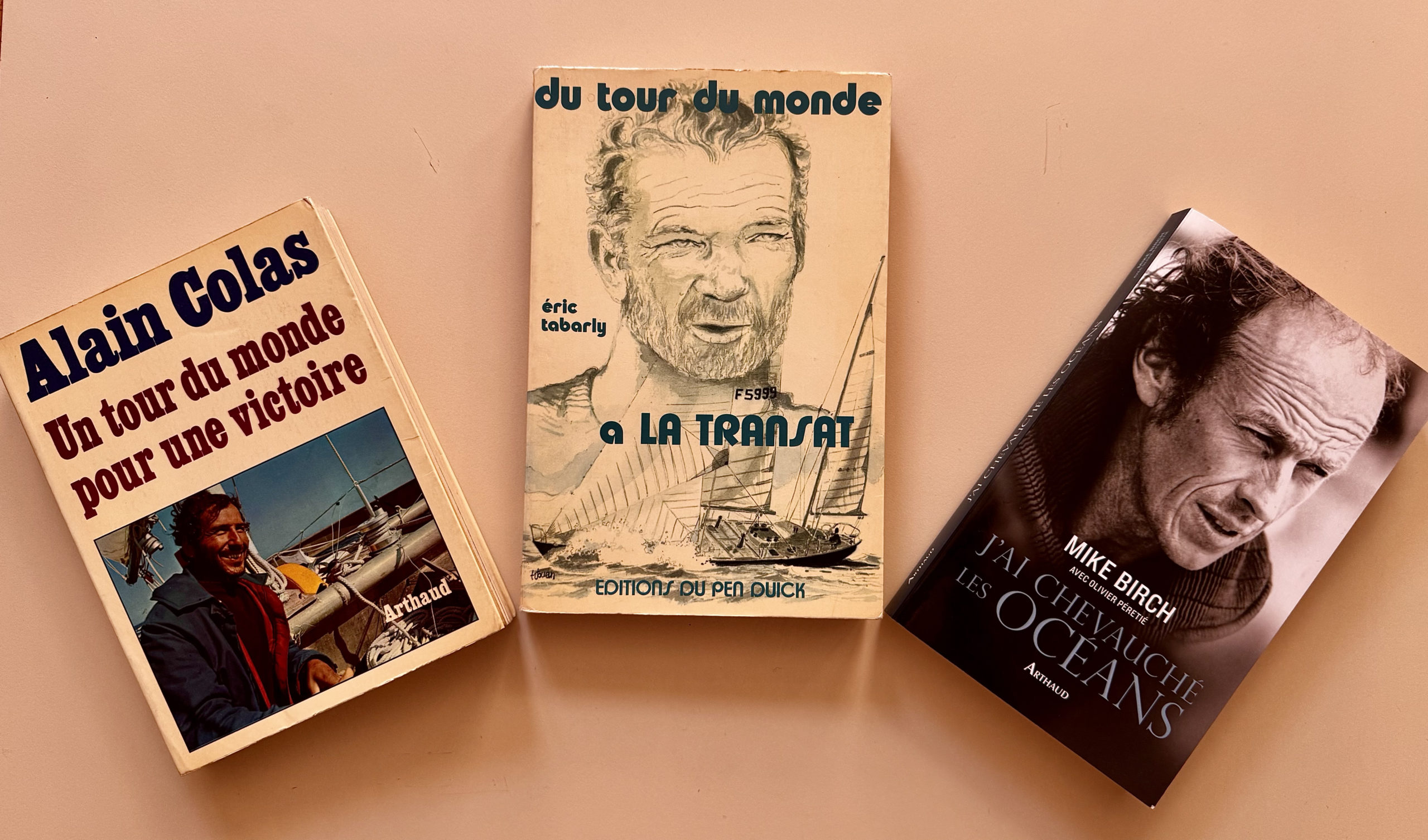
“Un tour du monde pour une victoire”, Alain Colas Arthaud, 1972
“Du tour du monde à la Transat”, Eric Tabarly, Éditions du Pen Duick, 1976
“J’ai chevauché les océans”, Mike Birch, Arthaud, 2017